

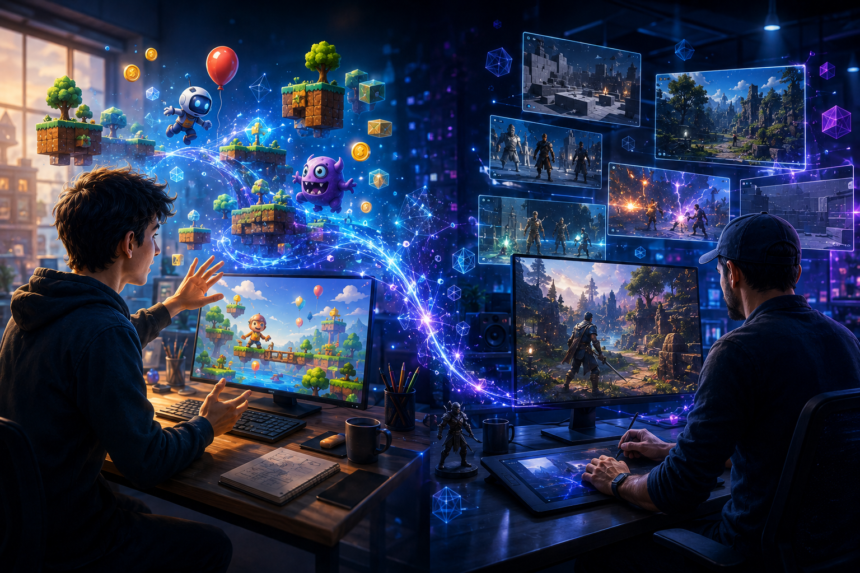
Beginners and indie developers face a similar problem from two different angles. Beginners often have enthusiasm but no technical foundation. Indie developers often have technical skill but limited time and no team to share the workload with. AI game creation tools address both problems at once, though in slightly different ways depending on which side of that gap you’re starting from.
Here’s how to actually use these tools well, whether you’re picking up game development for the first time or you’re an indie developer trying to do more with limited hours.
For Beginners: Removing the Technical Wall
You Don’t Need to Learn to Code First
The traditional path into game development required learning a programming language before you could test whether you even enjoyed the process. AI game maker tools remove that requirement entirely. You can describe an idea in plain language and get a working version back, which means you find out whether game development suits you within days, not months.
Mistakes Cost Far Less
Beginners learn by making mistakes, that’s true in any skill. What used to make mistakes expensive was the time required to fix them manually. When generating a new version takes minutes instead of days, beginners can afford to experiment freely, which accelerates learning considerably compared to a slower, higher-stakes process.
Start With Something Small and Familiar
Building something close to a genre you already understand as a player gives you an internal sense of what “good” feels like. A simple, casual concept, something like Pop All the Balloons, shows how a straightforward core mechanic, when genuinely well-tuned, can hold attention without needing complexity a beginner isn’t ready to manage yet.
For Indie Developers: Doing More With Limited Time
Prototyping Multiple Ideas Without the Usual Cost
Indie developers rarely have the luxury of building several full prototypes before choosing a direction. AI-assisted tools make that kind of exploration realistic, letting a solo developer or small team test more concepts before committing serious time to one, without the traditional cost of doing so.
Filling Skill Gaps Without Hiring
A solo indie developer strong in programming but weak in art, or vice versa, no longer has to either learn the missing skill from scratch or bring on additional people just to cover a single gap. AI-assisted asset generation and prototyping help cover that ground directly, at least well enough to test and iterate before deciding whether a dedicated specialist is worth bringing in later.
Faster Response to Playtesting Feedback
When implementation is faster, responding to playtest feedback becomes faster too. An indie developer can adjust a mechanic based on player reactions and have a new version ready to test again quickly, rather than waiting days or weeks for each round of changes.
What Beginners Should Actually Focus On
Understanding Why Something Feels Good, Not Just That It Does
It’s tempting to generate a version, notice it feels fun, and move on without examining why. Beginners benefit disproportionately from slowing down occasionally to ask what specifically made a version work, since that understanding builds design intuition that carries into future projects.
Playing Other Games With a Critical Eye
Beginners often play games purely for enjoyment without analyzing what makes them work. Developing the habit of noticing pacing, feedback, and difficulty choices in games you already play sharpens the instincts that make your own AI-assisted creation process more effective.
Finishing Something Small Before Attempting Something Big
The temptation to start with an ambitious idea is strong, but a finished small project teaches more than an abandoned large one. Beginners specifically benefit from the discipline of seeing a small project through to completion before scaling up.
What Indie Developers Should Actually Focus On
Using Speed for Validation, Not Just Production
The biggest value of fast prototyping for an indie developer isn’t producing more content faster, it’s validating whether an idea deserves further investment before committing serious time to it. Treat every rough prototype as a test, not a draft of the final product.
Protecting Time for Deep Polish
Faster implementation should free up time for the kind of deep, deliberate polish that separates a good indie game from a merely functional one. Don’t let saved time simply compress the entire timeline, redirect it toward the details that actually elevate a finished product.
Staying Differentiated Through Design, Not Just Speed
As AI-assisted tools become more common, speed alone stops being a competitive advantage since everyone has access to similar capabilities. What continues to differentiate one indie developer’s work from another is design sensibility, originality, and polish, the things that always mattered most.
A Practical Starting Point for Both
- Define your core loop clearly before generating anything. Clarity upfront produces a more useful starting point.
- Generate a rough version and play it immediately. Don’t adjust before experiencing it as-is.
- Get outside feedback early, even from just one or two people. Their reactions reveal things you stop noticing on your own.
- Iterate deliberately, one change at a time. Understand what specifically is improving the experience.
- Finish something, even if it’s small. A completed project, however modest, teaches more than an ambitious one left unfinished.
Where the Two Paths Converge
Despite starting from different places, technical newcomers and time-strapped indie developers end up needing the same fundamentals: a clear core idea, honest playtesting, and disciplined iteration. AI game creation tools remove the specific barrier each group struggled with most, technical skill for beginners, available time for indies, but the underlying process of building something genuinely good still depends on the same judgment and persistence it always has.
Final Thoughts
AI game creation tools haven’t lowered the bar for what makes a game worth playing. They’ve removed different barriers for different people, letting beginners test their interest without a steep technical learning curve, and letting indie developers stretch limited time further than manual development ever allowed.
What still separates a good result from a mediocre one is the same as it’s always been: a clear idea, honest testing, and the willingness to refine based on what actually happens when someone else plays it. The tools just make it realistic to get there, regardless of which side of the experience gap you’re starting from.