

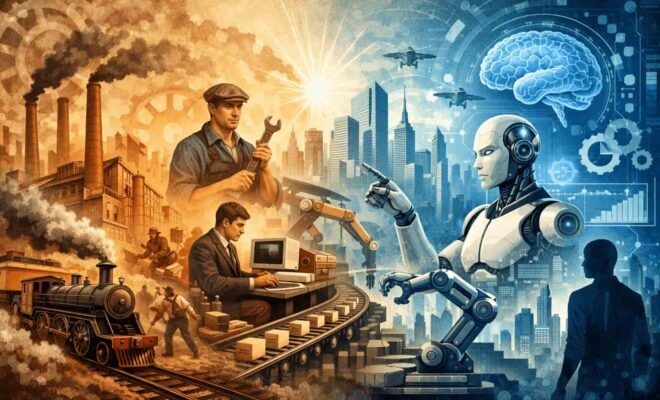
Robotics is rapidly transforming the way businesses operate across manufacturing, healthcare, logistics, agriculture, retail, and many other industries. Once mainly associated with large factory assembly lines, robots are becoming smarter, more flexible, and increasingly accessible to businesses of different sizes.
Advances in artificial intelligence (AI), machine learning, sensors, computer vision, and automation are expanding what robots can accomplish. In the future, robotics will play an even greater role in improving productivity, workplace safety, precision, and business efficiency.
What Is Business and Industrial Robotics?
Business and industrial robotics refers to the use of programmable machines to perform physical tasks automatically or with limited human assistance. These robots can handle repetitive, dangerous, highly precise, or physically demanding work.
Modern robots range from large industrial machines to collaborative robots, autonomous mobile robots, drones, and AI-powered service robots.
The Evolution of Industrial Robots
Traditional industrial robots were mainly designed for repetitive tasks in controlled environments. They were commonly used for welding, painting, assembly, and material handling.
Modern robotics is significantly more advanced. New systems can use sensors and AI to recognize objects, navigate changing environments, and adapt to different tasks. This evolution is making robotics useful in a much wider range of industries.
Artificial Intelligence and Smarter Robots
Artificial intelligence is one of the most important technologies shaping the future of robotics.
AI-powered robots can analyze information from sensors, cameras, and other systems to make better decisions. Machine learning also enables some robotic systems to improve their performance based on data and experience.
These capabilities support applications such as quality inspection, warehouse navigation, predictive maintenance, and intelligent automation.
Collaborative Robots in the Workplace
Collaborative robots, often called cobots, are designed to work alongside human employees.
Unlike many traditional industrial robots that operate in isolated areas, cobots can assist workers with tasks such as:
- Assembly
- Packaging
- Quality inspection
- Material handling
- Machine operation
The goal is often to combine human judgment and creativity with robotic precision and consistency.
Robotics in Manufacturing
Manufacturing remains one of the largest users of robotics.
Robots help manufacturers increase production speed, improve product consistency, and reduce errors. Advanced robotic systems can also support flexible production lines where equipment is reconfigured for different products.
Smart factories will increasingly connect robots with AI, sensors, cloud platforms, and real-time analytics.
Robotics in Logistics and Warehousing
The growth of e-commerce has increased demand for faster and more efficient logistics operations.
Warehouses increasingly use autonomous robots to move goods, assist with picking orders, and manage inventory. Robotic systems can operate continuously and help businesses process large numbers of orders more efficiently.
Future warehouses are expected to become even more automated while maintaining human oversight for complex decisions.
Healthcare and Medical Robotics
Robotics is also transforming healthcare.
Robotic technologies can support:
- Surgical procedures
- Rehabilitation
- Hospital logistics
- Laboratory automation
- Patient assistance
Medical robots can improve precision and help healthcare professionals perform certain tasks more efficiently. However, human expertise and careful oversight remain essential.
Robotics in Agriculture
Agricultural businesses are adopting robotics to address labor shortages and improve productivity.
Robots can assist with planting, harvesting, crop monitoring, weed control, and precision spraying. Drones and autonomous vehicles can also collect information about crop conditions.
These technologies may help farmers use resources more efficiently while increasing production.
The Rise of Autonomous Mobile Robots
Autonomous mobile robots can navigate workplaces without following fixed tracks.
Using cameras, sensors, and mapping technologies, these machines can move through warehouses, factories, hospitals, and other environments.
Their flexibility makes them valuable for organizations that need automation without completely redesigning existing facilities.
Benefits of Robotics for Businesses
Robotics can provide several important advantages.
Higher Productivity
Robots can perform repetitive tasks quickly and consistently.
Improved Safety
Machines can handle dangerous jobs involving heavy equipment, hazardous environments, or extreme conditions.
Greater Precision
Robotic systems can perform highly detailed tasks with consistent accuracy.
Lower Operational Costs
Although implementation can require significant investment, automation may reduce long-term operating costs.
Better Scalability
Businesses can use robotics to increase production and respond more efficiently to changing demand.
Challenges of Robotics Adoption
Despite its potential, robotics also creates challenges.
High Initial Costs
Purchasing equipment, integrating systems, and training employees can require substantial investment.
Skills Shortages
Businesses need professionals who can program, operate, maintain, and secure advanced robotic systems.
Cybersecurity Risks
Connected robots can create new security concerns that require strong protection.
Workforce Transition
Automation may change certain job roles, increasing the importance of retraining and professional development.
Technical Complexity
Integrating robots with existing equipment and software systems can be difficult.
How Robotics Will Change Jobs
Robotics is expected to transform many jobs rather than simply eliminate all human work.
Repetitive and physically demanding tasks are more likely to become automated, while demand may grow for roles involving:
- Robot maintenance
- Software development
- Data analysis
- Automation management
- Cybersecurity
- Human-machine collaboration
Education and workforce training will be important for helping employees adapt to changing job requirements.
Human-Robot Collaboration
The future workplace is likely to involve greater cooperation between people and machines.
Humans bring creativity, judgment, communication, and problem-solving abilities. Robots provide speed, precision, consistency, and the ability to perform repetitive tasks.
Combining these strengths can improve productivity while allowing employees to focus on higher-value responsibilities.
The Future of Robotics
Future robots are expected to become more intelligent, affordable, flexible, and easier to deploy.
Important developments may include:
- More advanced AI-powered robots
- Greater use of collaborative robotics
- Improved computer vision
- Wider adoption of autonomous systems
- Robotics-as-a-Service business models
- Better human-robot interaction
- Increased use of digital twins
As these technologies mature, robotics may become accessible to a broader range of businesses.
Conclusion
The future of robotics in business and industry is closely connected to advances in artificial intelligence, automation, sensors, and digital technologies. Robots are moving beyond traditional factory environments and becoming valuable tools in logistics, healthcare, agriculture, retail, and many other sectors.
Businesses that adopt robotics strategically can improve productivity, safety, precision, and operational efficiency. However, successful adoption also requires investment in cybersecurity, employee training, and responsible implementation.
As humans and intelligent machines increasingly work together, robotics will play a major role in shaping the workplaces and industries of the future.
Frequently Asked Questions (FAQs)
1. What is industrial robotics?
Industrial robotics involves using programmable machines to automate physical tasks in manufacturing and other business environments.
2. How is AI improving robotics?
AI helps robots analyze information, recognize objects, navigate environments, adapt to changing conditions, and make more intelligent decisions.
3. What are collaborative robots?
Collaborative robots, or cobots, are designed to work alongside human employees and assist with tasks such as assembly, inspection, and material handling.
4. Which industries use robotics the most?
Manufacturing, logistics, healthcare, agriculture, automotive production, and warehousing are among the leading users of robotic technologies.
5. Will robots replace human workers?
Robots will automate some tasks and change certain job roles, but they will also create demand for new skills in programming, maintenance, engineering, data analysis, and automation management.
6. What is the future of robotics in business?
The future will likely include smarter AI-powered robots, greater human-robot collaboration, more autonomous systems, improved affordability, and wider adoption across industries.