

How Fly Bait Stations Support Commercial Fly Control
Flies are one of the most persistent pest issues around commercial properties. They are common around food service areas, dumpsters, loading docks, outdoor patios, waste-handling zones, agricultural sites, and other locations where moisture, organic material, heat, and odors are present.
For pest management professionals, fly control is rarely solved with one action. A strong program usually combines sanitation recommendations, source reduction, monitoring, exterior treatments, customer education, and the right equipment. In many accounts, fly bait stations can become an important part of that long-term strategy.
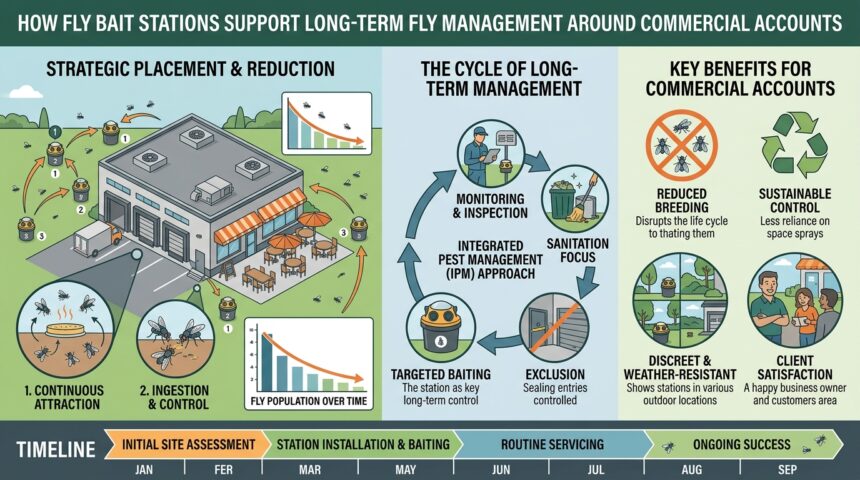
A fly bait station is not a replacement for sanitation or inspection. Instead, it supports a broader integrated pest management approach by giving professionals a controlled, serviceable, and targeted way to manage fly pressure in key areas.
Why Flies Become a Recurring Commercial Problem
Commercial fly issues often return because the conditions that attract flies are difficult to remove completely. A restaurant may clean daily but still have trash areas, drains, deliveries, grease, outdoor seating, and food waste. A warehouse or distribution site may have loading doors that open repeatedly. A grocery store, food processing facility, school, or hospitality property may have multiple risk zones spread across the property.
Common fly pressure points include:
- Dumpsters and trash enclosures
- Loading docks
- Outdoor dining areas
- Food-service entrances
- Grease collection areas
- Floor drains
- Organic debris
- Moisture-prone exterior zones
- Livestock or agricultural areas
- Shared commercial spaces
- Delivery and receiving doors
Because flies move quickly and reproduce in favorable conditions, fly management requires consistency. The visible adult flies are only part of the issue. Professionals also need to consider breeding sources, sanitation gaps, airflow, entry points, and exterior pressure.
Sanitation Is Essential, but It May Not Be Enough
Sanitation is the foundation of commercial fly control. Without it, any treatment program is likely to struggle.
A good service plan may include recommendations such as:
- Cleaning around dumpsters
- Keeping trash lids closed
- Removing organic buildup
- Managing grease and food waste
- Cleaning drains where appropriate
- Reducing standing water
- Improving door discipline
- Repairing screens or air curtains
- Keeping outdoor service areas maintained
However, even strong sanitation may not eliminate fly pressure completely. Commercial environments are active. Trash is generated daily. Doors open frequently. Customers, employees, deliveries, weather, and neighboring properties can all affect fly activity.
That is why pest management professionals often need tools that support ongoing fly suppression between service visits.
How Fly Bait Stations Fit Into IPM Programs
Integrated Pest Management focuses on using multiple tactics together. For flies, that may mean inspection, sanitation, exclusion, monitoring, source reduction, mechanical control, and targeted product use.
A fly bait station can support this type of program by creating a managed location where bait can be protected, inspected, replaced, and serviced more efficiently.
This can be useful because bait placement in commercial settings should be controlled and intentional. Stations can help keep bait positioned in strategic areas while supporting a cleaner and more professional service presentation.
For pest management companies, stations may also make the program easier to document and maintain. Instead of relying only on loose or temporary placements, a station-based approach gives technicians a more consistent service point to inspect during recurring visits.
Why Sheltered Bait Access Matters
Commercial fly programs are often exposed to weather, cleaning activity, customers, animals, landscaping, and property maintenance. If bait is not protected, it may break down faster, become less effective, or be disrupted by water and environmental conditions.
Sheltered bait access can help support a more reliable program by keeping the bait area more controlled.
A good fly bait station should consider:
- Fly access
- Weather resistance
- Serviceability
- Durability
- Secure placement
- Easy cleaning
- Compatibility with professional service routines
- Visual discretion where needed
The station should make the technician’s work easier, not harder. If a product is difficult to open, clean, inspect, or reinstall, it may reduce service efficiency over time.
Placement Strategy Should Match the Account
The best station strategy depends on the type of account and the fly pressure points found during inspection. A restaurant will not have the same layout as a warehouse, grocery store, hotel, school, farm, or food processing facility.
Professionals may consider areas such as:
- Dumpster pads
- Exterior walls near service zones
- Loading docks
- Waste-handling areas
- Outdoor patios
- Fence lines
- Utility zones
- Areas near vegetation
- Exterior areas where flies gather
Placement should always follow product labels, site requirements, and professional judgment. The goal is to support control where flies are active while keeping the program appropriate for the account.
Granular and Liquid Bait Considerations
Different fly programs may use different bait formats depending on the account, pest pressure, label requirements, and technician preference. Some situations may call for granular baits, while others may involve liquid bait options.
A station that works with more than one bait format can give technicians flexibility. This can be useful when service needs change by season, account type, weather, or fly pressure.
However, bait selection and use should always follow label directions. Pest management professionals should also consider account sensitivity, food safety expectations, weather exposure, and customer requirements before choosing a bait approach.
Service Efficiency Matters for Pest Control Companies
A fly program is only as strong as its maintenance. Stations need to be inspected, cleaned, refreshed, and documented as part of recurring service.
For technicians, service efficiency matters because commercial accounts may include multiple stations across large properties. A station that is easy to access and clean can help reduce service friction.
Useful station features may include:
- Removable trays
- Easy inspection access
- Secure mounting options
- Durable construction
- Clear service points
- Compatibility with technician routines
- Stable placement in outdoor areas
When equipment is practical, technicians are more likely to maintain it consistently. That consistency can improve the overall program.
Fly Control Supports Customer Experience
For commercial properties, flies affect more than sanitation. They can also affect customer perception.
A fly near a restaurant table, reception area, hotel entrance, grocery display, or food-service counter can quickly create concern. Even when the facility is professionally managed, customers may interpret visible flies as a sign of poor cleanliness.
This makes fly control important for:
- Restaurants
- Cafés
- Grocery stores
- Schools
- Hotels
- Healthcare facilities
- Food warehouses
- Commercial kitchens
- Outdoor event spaces
- Property management accounts
A visible fly issue can also create pressure on managers and staff. Preventive fly management helps reduce that risk before activity becomes disruptive.
Exterior Fly Pressure Often Connects With Other Pests
Commercial exterior pest pressure is often connected. Areas that attract flies may also support mosquitoes, ants, cockroaches, rodents, or other pests.
Standing water, organic debris, dumpsters, vegetation, and poor drainage can create overlapping pest concerns. For this reason, a commercial pest program may need multiple tools working together.
For example, a property with fly pressure around waste areas may also need exterior inspection for moisture, sanitation issues, and mosquito conditions. When mosquito pressure is part of the program, a professional mosquito control station may support a broader exterior service strategy.
The key is to evaluate the whole property rather than treating each pest issue in isolation.
Choosing Equipment for Long-Term Programs
Fly control equipment should be selected for repeated professional use. A product that performs well for one visit but becomes difficult to maintain over time may not be ideal for recurring commercial accounts.
Pest management professionals should consider:
- Durability
- Weather exposure
- Ease of cleaning
- Ease of bait replacement
- Mounting flexibility
- Resistance to tampering or disruption
- Compatibility with service documentation
- Professional appearance
- Long-term field use
The equipment should support the technician, the account, and the overall pest management plan.
Fly Bait Stations Work Best as Part of a Complete Program
Fly bait stations can be valuable, but they should not be used as a standalone solution. The strongest commercial fly programs combine multiple steps.
A complete plan may include:
- Inspection
- Source identification
- Sanitation recommendations
- Drain or waste-area review
- Entry-point awareness
- Monitoring
- Station placement
- Regular service
- Documentation
- Customer communication
This approach helps property managers and business owners understand not only what is being done, but why the problem is happening and how it can be reduced over time.
A Practical Tool for Professional Fly Management
Commercial fly control requires consistency, planning, and professional-grade equipment. Flies can return quickly when food, waste, moisture, and access remain available, so long-term management needs more than a one-time treatment.
Fly bait stations can help pest management professionals create a more controlled, serviceable, and repeatable fly program around commercial accounts. They support targeted bait access, regular maintenance, and a cleaner service process.
VM Products manufactures professional pest management tools for the industry, including the FBS1® Fly Bait Station and other service-focused products. For pest management professionals handling commercial fly accounts, the right equipment can make fly programs more efficient, more organized, and easier to maintain over time.