

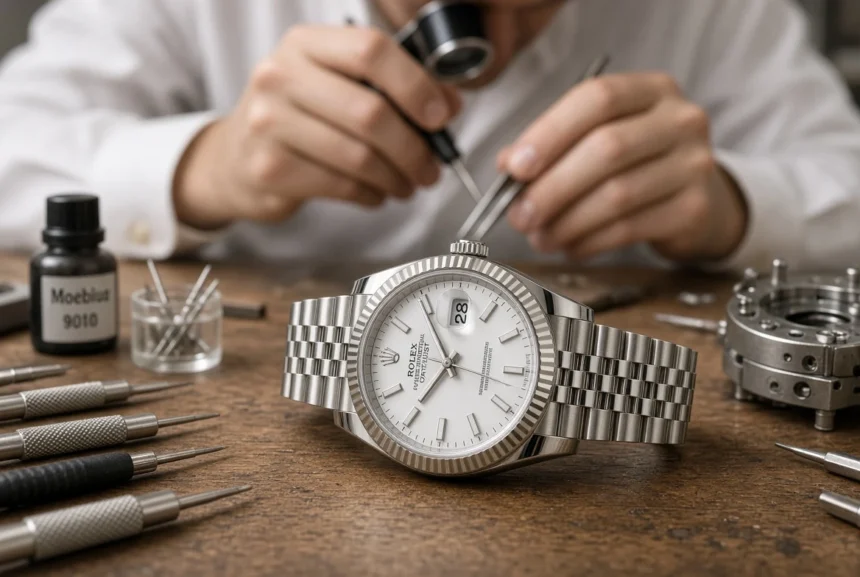
Fake Rolex watches have become remarkably sophisticated. A quick look at the dial is no longer enough, and relying on a single detail, such as the serial number, can create a false sense of security.
A proper authentication looks at the watch as a whole: its serial and reference numbers, construction, movement, documentation, and provenance. It should also check whether the watch has been reported lost or stolen.
You can spot some warning signs at home. For a valuable purchase, however, there is no substitute for an inspection by an experienced watchmaker.
Start With the Serial and Reference Numbers
Rolex identification numbers have changed in both format and location over the years.
On many older watches, the serial number is engraved between the lugs at 6 o’clock and requires removal of the bracelet to see it. Rolex later introduced serial numbers on the rehaut, the inner ring between the dial and crystal. Modern references generally carry the serial number there.
Around 2010, Rolex moved from sequential serial numbers to randomized alphanumeric codes. As a result, a modern Rolex serial number cannot usually be used to determine an exact production year.
The engraving itself is worth examining. It should be clean, precise, and appropriate for the reference and period. Poorly executed or irregular markings deserve closer attention.
A convincing serial number, however, proves very little on its own. Counterfeit watches can carry copied numbers taken from genuine examples. Serial and reference numbers should always be considered alongside the watch itself, its movement and its documentation.
Examine the Watch
Start with the dial, hands, hour markers, crown, bezel, bracelet and clasp. The quality of the finishing should be high throughout, but more importantly, every component should be correct for the specific reference and period.
On models fitted with a Cyclops lens, the date should be clearly magnified and the lens correctly positioned. Weak magnification or poor alignment can be a warning sign, but neither proves that a watch is fake.
Weight is another useful clue, though not a reliable test by itself. Rolex has produced watches in many different metals and configurations, while high-quality replicas can now reproduce the weight of an original surprisingly well.
The same applies to the seconds hand. Most mechanical Rolex movements produce a rapid progression of the hand rather than the once-per-second tick of a conventional quartz watch. But Rolex also produced genuine quartz models, including the Oysterquartz, so this check only makes sense when you know the reference.
The Movement Matters
This is where professional authentication becomes particularly important.
High-grade replicas can reproduce case dimensions, bracelets, dials, rehaut engravings and even the appearance of a Rolex movement with impressive accuracy.
Opening the watch allows a specialist to determine whether the movement is correct for the model and period, and to examine details that cannot be assessed from photographs.
It can also reveal a different issue: a genuine Rolex fitted with incorrect, replacement or non-original components.
Opening a Rolex requires the correct tools and experience. It should be left to a professional.
Check the Crystal, Caseback and Engravings
Many modern Rolex watches have a microscopic coronet laser-etched into the crystal near 6 o’clock. It can be difficult to see without magnification and the right lighting.
It is a useful detail, but not proof of authenticity. Crystals can be replaced, and sophisticated counterfeiters can reproduce features that were once considered difficult to copy.
The same rule applies to the caseback and external engravings. Most Rolex watches have solid metal casebacks, but exceptions exist. Rather than relying on general rules, check that the details are correct for the exact reference and production period.
Check Whether the Watch Has Been Reported Lost or Stolen
Authenticity and provenance are separate issues. A Rolex can be completely genuine and still have been reported lost or stolen.
The serial number should therefore be checked against an established lost-and-stolen watch database.
The Watch Register, operated by the Art Loss Register, maintains records of lost and stolen watches and allows watches to be screened using their identifying information.
This check does not authenticate the watch. Its purpose is to establish whether the watch has previously been reported lost or stolen. Reputable dealers should include this type of screening in their due diligence before offering a watch for sale.
Check the Papers
Original papers are valuable, but they are not proof of authenticity.
Warranty cards, certificates, boxes, and accessories can be forged or paired with another watch. What matters is whether the information is consistent.
Check that the serial and reference details correspond to the watch and that the documentation is appropriate for the model and period.
Rolex service records or documentation from a reputable specialist can add useful provenance. Digital watch passports and independent certification services can do the same, but they should support a physical inspection rather than replace it.
Why One Check Is Never Enough
There is no single test that can reliably authenticate every Rolex.
A serial number is not enough. Neither are the weight, Cyclops lens, crystal coronet, papers, or movement of the seconds hand.
Modern high-grade counterfeits can reproduce several of these features well enough to survive a casual inspection. For a serious purchase, authentication should combine identification and provenance checks with a physical examination by an experienced specialist, including inspection of the movement when necessary.
This is the process WATCHOYSTER applies to every watch it lists. A certified watchmaker inspects each piece in the company’s own workshop, and every serial number is checked against The Watch Register before the watch goes into the catalog. The buyer gets the result of these steps up front and does not have to work through them alone. Each watch comes with a 12-month warranty, and returns are accepted within 14 days of delivery if the watch differs materially from its listing or has an undisclosed defect.
To see how this looks in practice, browse the current selection of Men’s Watches, which includes Rolex alongside more than 90 other luxury brands, each inspected and checked before sale.
Every watch is also covered by a 12-month warranty and the applicable return policy.
Browse our current selection of Men’s Watches, including Rolex and more than 90 other luxury watch brands.