

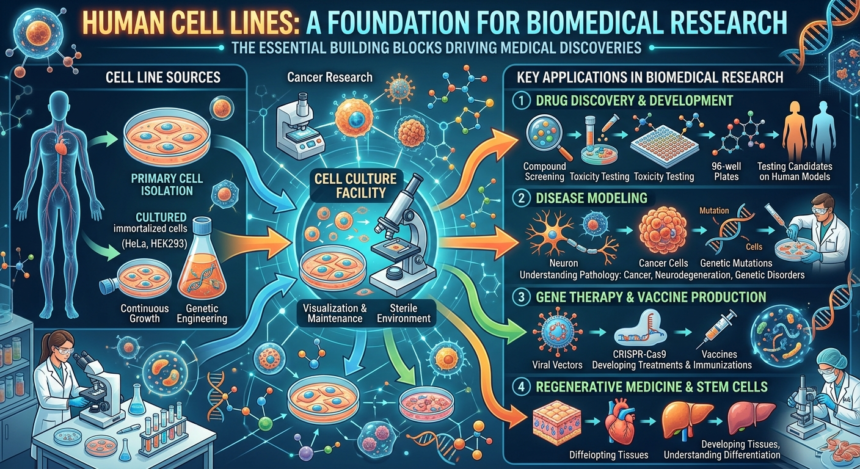
Human cell lines have become one of the most valuable tools in modern biomedical science. They allow researchers to investigate cellular biology under controlled laboratory conditions, evaluate new therapeutic approaches, study disease mechanisms, and accelerate drug discovery without relying exclusively on primary patient samples.
Over the past several decades, advances in cell culture technology, molecular biology, and genomic analysis have dramatically expanded the applications of human cell lines. Today they are routinely used by pharmaceutical companies, biotechnology organizations, academic laboratories, and contract research organizations to support research ranging from basic cell biology to precision medicine.
Although new technologies such as organoids and patient-derived explants continue to gain attention, human cell lines remain an essential experimental platform because they provide reproducible, scalable, and well-characterized biological models.
What Are Human Cell Lines?
A human cell line is a population of cells that can be maintained and propagated in vitro under controlled laboratory conditions.
Unlike primary cells, which typically have a limited lifespan, many established cell lines can be cultured for extended periods while maintaining relatively stable biological characteristics.
Human cell lines are widely used to investigate:
- Cell signaling
- Gene expression
- Molecular pathways
- Drug response
- Cancer biology
- Immunology
- Virology
- Toxicology
- Regenerative medicine
- Functional genomics
Because experiments can be repeated under identical laboratory conditions, cell lines have become indispensable for generating reproducible scientific data.
Why Researchers Continue To Use Cell Lines
Despite the growing availability of advanced biological models, human cell lines continue to offer several important advantages.
These include:
- High experimental reproducibility
- Controlled laboratory conditions
- Large-scale expansion
- Cost-effective experimentation
- Compatibility with automation
- Genetic manipulation
- High-throughput drug screening
- Long-term availability
These characteristics make cell lines particularly valuable during the early stages of biomedical research and pharmaceutical development.
Applications Across Biomedical Research
Human cell lines support investigations across virtually every area of life science.
Common applications include:
Cancer Research
Cancer cell lines remain among the most widely used laboratory models.
Researchers use them to study:
- Tumor biology
- Cell proliferation
- Metastatic mechanisms
- Drug resistance
- Biomarker discovery
- Target validation
Many important oncology therapies have been developed using data generated from human cancer cell lines before progressing to animal studies and clinical trials.
Drug Discovery
Pharmaceutical companies routinely utilize human cell lines during early drug discovery.
Cell-based screening enables investigators to evaluate:
- Target engagement
- Cellular toxicity
- Mechanism of action
- Pharmacological activity
- Dose-response relationships
- Candidate compound selection
Using standardized laboratory models allows thousands of compounds to be evaluated efficiently before entering more complex preclinical studies.
Molecular Biology
Human cell lines provide ideal systems for studying molecular mechanisms that regulate cellular function.
Researchers investigate:
- Gene regulation
- Protein expression
- Signal transduction
- Epigenetic modifications
- RNA biology
- CRISPR gene editing
- Transcriptomics
- Proteomics
The ability to manipulate genetic pathways under controlled conditions has transformed modern molecular biology.
Authentication And Quality Control
One of the most important considerations in cell culture research is authentication.
Misidentified or contaminated cell lines have historically contributed to irreproducible research and inaccurate scientific conclusions.
Current best practices recommend routine verification through methods such as:
- STR profiling
- Mycoplasma testing
- Species verification
- Genetic authentication
- Morphological assessment
- Passage number monitoring
The National Cancer Institute highlights the importance of monitoring passage numbers, testing for microbial contamination, and maintaining quality management systems to preserve the integrity of research cell lines.
Maintaining authenticated cultures helps ensure that experimental results accurately represent the intended biological model.
Human Cell Lines And Emerging Technologies
Modern biomedical research increasingly combines traditional cell lines with advanced analytical platforms.
Today, researchers integrate cell line studies with:
- Next-generation sequencing
- Single-cell sequencing
- Spatial transcriptomics
- Artificial intelligence
- High-content imaging
- Multi-omics analysis
- CRISPR functional screening
These technologies allow scientists to generate comprehensive molecular datasets that improve understanding of disease biology while identifying potential therapeutic targets.
Human cell lines frequently serve as the first experimental system used to validate discoveries before transitioning into more complex biological models.
Choosing Appropriate Cell Models
Selecting the right cell line depends on the objectives of a particular research project.
Important considerations include:
- Tissue origin
- Disease relevance
- Genetic background
- Mutation profile
- Growth characteristics
- Experimental compatibility
- Authentication status
- Quality documentation
Careful model selection improves the biological relevance of experimental findings while reducing unnecessary variability between studies.
Beyond Traditional Cell Lines
Although immortalized cell lines remain widely used, many laboratories now complement them with additional experimental models.
These may include:
- Primary human cells
- Patient-derived explants
- Three-dimensional cultures
- Organoids
- Co-culture systems
- Induced pluripotent stem cells (iPSCs)
Combining multiple model systems allows investigators to better reproduce the complexity of human disease while maintaining the efficiency offered by established cell lines.
Supporting Biomedical Innovation
Modern biomedical research increasingly depends on reliable biological resources that support reproducible experimentation.
Organizations such as cell bio contribute to this ecosystem by providing researchers with access to human cell-based research solutions that can support studies in oncology, neuroscience, immunology, regenerative medicine, molecular biology, and translational research.
Access to well-characterized cellular models, combined with standardized quality control procedures, helps investigators generate consistent experimental data while accelerating scientific discovery.
Looking Forward
Human cell lines will continue to play a central role in biomedical research for many years to come. Although increasingly sophisticated biological models are expanding the possibilities of laboratory science, cell lines remain the foundation upon which much of modern drug discovery, molecular biology, and translational medicine is built.
Future advances in genomics, precision medicine, artificial intelligence, and cell engineering will likely make these laboratory models even more informative. When combined with rigorous authentication, standardized quality management, and carefully designed experimental protocols, human cell lines will remain indispensable tools for understanding human biology and developing the next generation of diagnostics and therapies. The NCI continues to emphasize standardized quality management and authentication practices as key elements supporting reproducible biomedical research.