
The word isometric appears in several fields, including fitness, mathematics, engineering, architecture, and graphic design. Although its meaning can change slightly depending on the subject, the basic idea remains connected to equal measurements or maintaining the same length. Understanding the isometric meaning can help you recognize how this concept works in different situations.
You may have heard about isometric exercises at the gym, seen isometric drawings in technical books, or encountered isometric transformations during mathematics lessons. These applications might seem unrelated at first, but they share important underlying principles. Each involves preserving particular measurements, dimensions, or positions.
This guide explains what isometric means, where the term comes from, how it is used, and why it matters. You will also discover practical examples that make the concept easier to understand.
What Does Isometric Mean?
The term isometric generally refers to something involving equal measurements or dimensions that remain unchanged. It comes from Greek roots meaning equal and measure. However, its precise definition depends on the context because mathematics, exercise science, and technical drawing use the term to describe different properties.
In mathematics, an isometric transformation preserves distances between points. This means an object can change its position or orientation without changing its shape or size. For example, moving a triangle across a flat surface without stretching or distorting it represents a basic form of isometric transformation.
In fitness, the term describes muscle contractions that produce tension without a substantial change in muscle length. Holding a plank or maintaining a wall-sit position provides a familiar example. Although these uses differ from mathematical transformations, the shared idea involves maintaining a particular measurement while other conditions may change.
Origin and Etymology of the Word Isometric
The word isometric originates from the Greek words isos, meaning equal, and metron, meaning measure. Combining these roots creates the general meaning of equal measurement. This origin explains why the term appears in several technical disciplines where distances, dimensions, and relationships between objects are important.
As mathematics and engineering developed, isometric became associated with specific methods of representing or transforming geometric objects. Technical drawing adopted the term to describe a standardized way of displaying three-dimensional forms on flat surfaces. These applications made isometric an important concept in architecture, manufacturing, and engineering education.
Exercise science uses the same word to describe a different physical process involving muscle tension. During an isometric contraction, a muscle generates force without noticeable movement at the associated joint. Understanding the word’s origin helps explain the connection between its different meanings while recognizing that each discipline applies it differently.
Isometric Meaning in Mathematics
In mathematics, an isometry is a transformation that preserves the distance between any two points. Objects undergoing an isometric transformation retain their original dimensions and geometric relationships. This concept is important because it allows shapes to change location or orientation without becoming larger, smaller, or distorted.
Common examples of isometric transformations include translations, rotations, and reflections. Translation moves an object from one position to another, while rotation turns it around a fixed point. Reflection creates a mirror image across a specified line or plane, preserving distances even though the object’s orientation may change.
Isometries are useful in geometry because they help explain congruence and spatial relationships. Two geometric figures are congruent when one can be mapped onto the other through an appropriate distance-preserving transformation. These principles also support computer graphics, robotics, engineering simulations, and mathematical models involving movement and positioning.
Isometric Meaning in Exercise and Fitness
In fitness, isometric exercise involves contracting muscles while maintaining a relatively fixed position. Unlike exercises that involve repeated joint movement, isometric activities create muscular tension without substantial changes in muscle length. These exercises are commonly used in strength training, physical rehabilitation, and programs designed to improve muscular endurance.
A familiar example is holding a plank position while keeping the body supported and stable. The muscles of the abdomen, shoulders, and other areas work to maintain the position. Wall sits and static holds provide additional examples of isometric exercise because the muscles remain active even when visible movement is limited.
Isometric training can help improve strength in the positions being trained and may support joint stability. However, its effectiveness depends on factors such as exercise selection, intensity, and individual physical condition. People with certain cardiovascular concerns should seek medical guidance before attempting particularly strenuous sustained contractions because these activities can temporarily increase blood pressure.
How Isometric Muscle Contractions Work
Muscles generate force through interactions between specialized proteins inside their fibers. During an isometric contraction, muscle tension develops without a substantial change in overall muscle length. This occurs when the muscular force is balanced by an opposing force, such as an external load or resistance from the surrounding environment.
Consider holding a moderately heavy object in one position without raising or lowering it. Your muscles must continue producing force to maintain the object’s position against gravity. Although the movement appears stationary, the muscles remain active, and maintaining the contraction requires energy.
Isometric contractions are an important part of ordinary movement and posture. Muscles frequently work to stabilize joints while other body parts move or remain supported. For example, maintaining an upright sitting position involves coordinated muscular activity that helps support the body and control unwanted movement throughout everyday tasks.
Common Examples of Isometric Exercises
The plank is one of the most recognizable examples of an isometric exercise. During a traditional plank, the body remains supported by the forearms and toes while the trunk muscles help maintain alignment. The exercise emphasizes holding a stable position rather than repeatedly moving through a large range of motion.
A wall sit is another common example, involving a supported seated position against a wall. The leg muscles remain active while the body maintains the chosen position. Other examples include static calf raises, certain yoga poses, and holding a resistance exercise at a fixed joint angle.
Different isometric exercises place demands on different muscle groups and joints. Beginners may benefit from shorter, comfortable holds before gradually increasing the duration according to their abilities. Maintaining normal breathing and avoiding unnecessary strain are important, particularly for individuals who experience discomfort or have medical conditions requiring exercise modifications.
Benefits of Isometric Exercises
One advantage of isometric exercise is that it can strengthen muscles without requiring repeated joint movement. This characteristic makes certain exercises useful when a person needs to work within a limited or controlled movement range. However, the appropriate exercise should always match individual abilities, physical limitations, and rehabilitation requirements.
Isometric exercises can also improve muscular endurance and the ability to maintain stable positions. Strength gains often occur most prominently near the joint angles being trained, although some improvements may transfer to nearby positions. Combining static contractions with other suitable forms of exercise can provide a more varied approach to physical conditioning.
Another benefit is that some isometric activities require little equipment and can be performed in different environments. Simple exercises such as supported static holds may fit into home or gym routines. Nevertheless, proper exercise selection and technique remain important because prolonged or overly intense contractions can cause unnecessary strain.
Isometric vs. Isotonic Exercises: Key Differences
Isometric and isotonic exercises both involve muscular force, but they describe different types of activity. Isometric exercises produce tension while muscle length remains approximately unchanged. Isotonic contractions, in their classical definition, involve movement while muscle tension remains relatively constant, although real-world resistance exercises rarely maintain perfectly constant tension.
During a typical biceps curl, the elbow bends and straightens while the muscles change length. This movement differs from holding a weight in a fixed position during an isometric exercise. The distinction helps explain why strength training programs often include both moving exercises and stationary holds.
Neither exercise category is automatically superior in every situation. Dynamic exercises can develop strength across a range of movement, while isometric training is useful for emphasizing particular positions and stabilization demands. A balanced approach may incorporate both methods depending on personal goals, available equipment, and individual comfort.
What Is an Isometric Drawing?
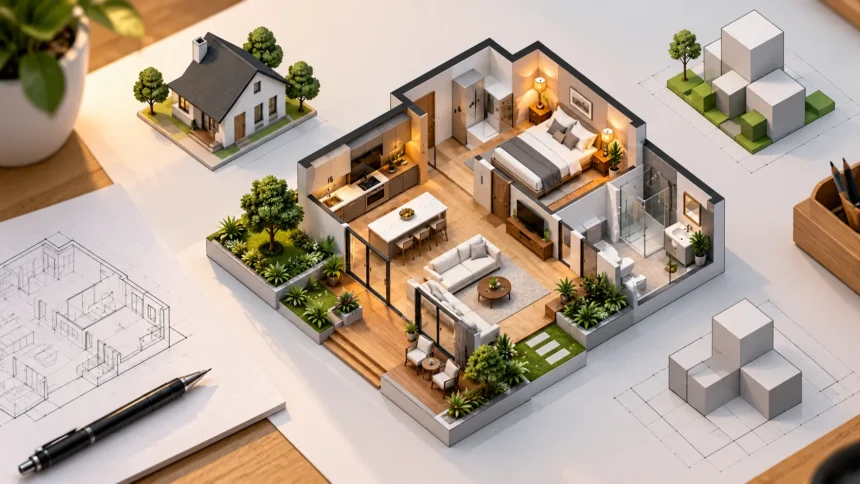
An isometric drawing is a method of representing a three-dimensional object on a two-dimensional surface. It allows viewers to see several sides of an object within a single illustration. This technique is widely used in engineering, architecture, technical communication, and product design because it clearly communicates spatial relationships.
In a conventional isometric drawing, the three principal directions are represented by axes separated by 120 degrees. Vertical edges usually appear vertical, while the other principal axes slope at approximately 30 degrees to the horizontal. These relationships produce a consistent view without the converging lines associated with traditional perspective drawing.
Isometric drawings are particularly helpful when illustrating furniture, machinery, buildings, and mechanical components. Designers can communicate the general structure and arrangement of objects without creating separate views for every side. However, true isometric projection and practical isometric drawing conventions differ slightly in how they represent dimensional scaling.
Isometric Projection in Engineering
Isometric projection is a form of axonometric projection used to represent three-dimensional objects in technical graphics. In a true isometric projection, the three principal axes are equally foreshortened. This arrangement creates a consistent visual representation of an object while preserving parallel relationships along corresponding directions.
Engineers use isometric views to communicate the appearance and arrangement of mechanical components. These illustrations can make complicated structures easier to understand than certain isolated technical views. However, conventional orthographic drawings are generally more suitable when precise dimensions and manufacturing specifications must be communicated.
Computer-aided design software frequently includes isometric viewing options that help users inspect digital models. These views are useful for understanding how components fit together and identifying potential spatial relationships. Isometric projection therefore remains a valuable communication method in modern engineering, industrial design, and technical visualization.
Isometric Meaning in Graphic Design
In graphic design, isometric illustrations create a three-dimensional appearance using consistent geometric angles. Designers often use this style to represent buildings, objects, digital interfaces, and complex ideas. Its structured appearance makes it particularly popular for educational graphics, technology illustrations, and diagrams explaining how systems work.
Isometric graphic design differs from realistic perspective artwork because parallel lines generally remain parallel instead of converging toward vanishing points. This creates a clean, organized appearance that helps viewers compare objects within the same visual environment. Designers can arrange multiple components while maintaining a consistent sense of depth and proportion.
Modern digital illustrations frequently use isometric layouts to explain software features, business workflows, and technical processes. The style allows complicated information to be presented through recognizable visual objects. Although artistic illustrations may not follow every mathematical rule precisely, the underlying geometric approach remains an important part of their visual structure.
Isometric Meaning in Video Games
Isometric games use a viewing style that presents environments from an angled, elevated perspective. This viewpoint allows players to see multiple sides of buildings, characters, and other objects within the game world. It is commonly associated with strategy games, role-playing games, and simulation titles that benefit from an overview of the environment.
Classic games often used isometric or isometric-like graphics to create the appearance of three-dimensional environments using two-dimensional artwork. This approach allowed developers to display detailed worlds while working within the technical limitations of earlier hardware. Modern games may recreate similar visual styles using advanced three-dimensional rendering systems.
The term isometric is sometimes used loosely in gaming to describe several types of angled overhead views. Not every game marketed as isometric follows the exact geometric requirements of true isometric projection. Nevertheless, the style remains popular because it provides a clear perspective on environments and supports intuitive navigation through complex spaces.
Where Isometric Concepts Are Used in Everyday Life
Isometric concepts appear in ordinary activities more often than many people realize. Holding a shopping bag steady, maintaining posture while sitting, or supporting an object against gravity can involve isometric muscular activity. These examples demonstrate that muscles do not always need visible movement to produce meaningful force.
Furniture assembly instructions and product diagrams also frequently use isometric illustrations. Showing multiple sides of an object makes it easier to understand where components belong and how pieces connect. Similar visual methods appear in instruction manuals, educational textbooks, and diagrams explaining the organization of different objects.
Digital applications, architectural presentations, and interactive maps sometimes use isometric-style graphics to communicate information. Their consistent angles can make complex arrangements appear organized and understandable. Recognizing these examples helps connect the word isometric with practical situations involving movement, stability, measurement, and visual representation.
Common Misunderstandings About Isometric Meaning
A common misunderstanding is that isometric always means something remains completely motionless. This interpretation applies loosely to certain muscle contractions but does not accurately describe every use of the word. In mathematics, an isometric transformation can involve substantial movement, provided that distances between points remain unchanged.
Another misconception is that isometric drawings represent objects exactly as human eyes would see them. In reality, isometric projection uses standardized geometric relationships rather than conventional visual perspective. Objects do not become smaller merely because they appear farther away, which makes the illustration useful for technical communication.
People also sometimes assume that isometric exercises cannot develop meaningful strength because they involve little visible movement. However, muscles can generate substantial force during stationary contractions. Understanding the context of the term is essential because mathematical transformations, technical illustrations, and muscle contractions follow different principles despite sharing the same descriptive word.
Conclusion
The isometric meaning is closely connected to equal measurements and the preservation of specific dimensions or relationships. Although the term appears in several fields, its precise interpretation depends on the subject being discussed. In mathematics, isometric transformations preserve distances, while exercise science uses the term to describe muscle contractions without substantial changes in length.
Isometric concepts also play an important role in engineering, architecture, graphic design, and video games. Technical drawings use consistent geometric angles to communicate three-dimensional forms, while digital illustrations apply similar principles to organize visual information. Understanding these applications makes the term easier to recognize in everyday situations.
Whether you encounter isometric exercises, mathematical transformations, or technical illustrations, the central idea involves maintaining particular measurements or conditions. Learning how the concept applies in different contexts improves your understanding of geometry, movement, and design. With a few practical examples, the meaning of isometric becomes straightforward and easy to remember.
Frequently Asked Questions (FAQs)
What is the simple meaning of isometric?
Isometric generally means relating to equal measurements. In mathematics, it describes distance-preserving transformations, while in exercise science, it refers to muscle contractions that produce tension without substantial changes in muscle length.
What is an example of an isometric exercise?
A plank is a common example of an isometric exercise because several muscle groups generate tension while the body maintains a relatively fixed position. Wall sits are another familiar example.
What does isometric mean in mathematics?
In mathematics, isometric refers to transformations that preserve distances between points. Translations, rotations, and reflections are common examples because they change an object’s position or orientation without altering its dimensions.
What is the difference between isometric and isotonic?
Isometric contractions generate muscular tension without substantial muscle length changes. Isotonic contractions classically involve muscle shortening or lengthening under relatively constant tension, although actual exercise movements often involve changing forces.
Where are isometric drawings commonly used?
Isometric drawings are widely used in engineering, architecture, product design, furniture instructions, and technical illustrations. They help represent three-dimensional objects on flat surfaces using consistent geometric relationships.