

Why Polygraph Examinations Are Still Relevant Today
Trust is an important part of personal relationships, employment, business partnerships, and legal disputes. However, there are situations where conflicting statements, missing information, or serious accusations make it difficult to establish what actually happened through ordinary conversations alone.
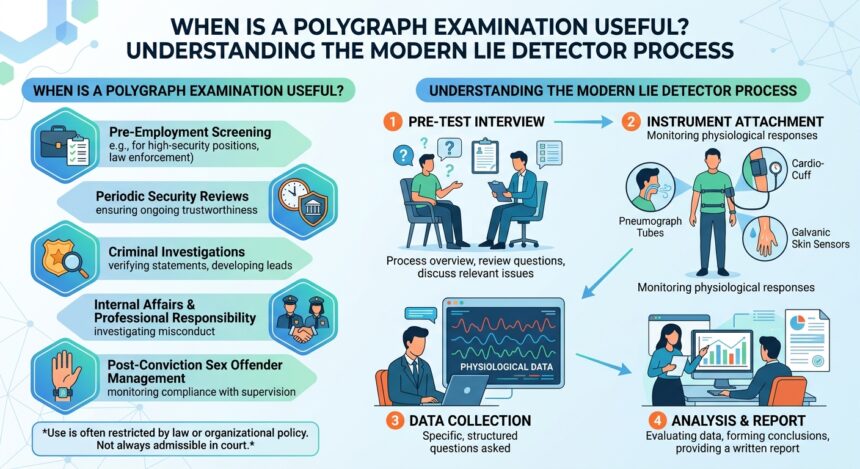
This is one reason professional polygraph examinations continue to attract interest. A polygraph, commonly called a lie detector, is designed to record physiological responses while a person answers carefully structured questions. The resulting data is then reviewed and interpreted by a trained examiner rather than being treated as an automatic determination of truth or deception.
Modern polygraph examinations can be used in a variety of circumstances. Depending on the situation, they may be relevant to personal disputes, employee screening, internal investigations, domestic staff verification, business concerns, and certain forensic or legal contexts. Professional organizations such as the Union of Polygraphers of Ukraine provide examinations for both individuals and businesses and work with certified specialists across multiple locations.
What Does a Polygraph Actually Measure?
A common misconception is that a polygraph machine simply detects whether someone is lying. In reality, the equipment records physiological reactions that occur while the examinee responds to questions.
During a professional examination, several physiological channels can be monitored, including:
- Respiration and changes in breathing patterns
- Cardiovascular activity
- Electrodermal activity associated with changes in skin conductivity
- Other physiological responses relevant to the examination
The examiner then considers these measurements in the context of the questions asked and the overall structure of the examination.
This distinction is important. A polygraph is not a machine that independently announces whether an answer is true or false. The quality of the examination depends on appropriate preparation, clearly formulated questions, suitable testing conditions, qualified examination, and careful analysis of the collected data.
When Can Polygraph Testing Be Considered?
There is no single situation in which everyone needs a polygraph examination. Instead, the procedure may be considered when an unresolved question has significant personal, professional, financial, or legal consequences.
1. Personal and Family Disputes
Relationships can become difficult when one person believes important information is being hidden. Questions concerning infidelity, financial behavior, or other disputed events can create prolonged uncertainty.
A professionally conducted examination may provide additional information when ordinary communication has failed to resolve a specific issue. SPU, for example, lists services relating to marital infidelity, family conflicts, pre-marriage checks, and other individual circumstances.
2. Employee Screening
Businesses sometimes need additional tools to manage risks associated with sensitive positions. Depending on applicable laws and organizational policies, polygraph examinations may be considered for personnel screening or periodic checks.
The objective should be clearly defined before testing. Rather than asking broad questions about someone’s character, an examination should focus on specific issues that can be meaningfully addressed.
Professional polygraph services can also be used in connection with internal investigations, employee departures, and workplace-related concerns.
3. Internal Business Investigations
When theft, information leakage, fraud, or another serious internal incident occurs, management may need to establish a clearer understanding of the circumstances.
A polygraph examination can form part of a broader investigation. It should not replace financial records, digital evidence, interviews, access logs, or other relevant documentation. Instead, it can be considered alongside other investigative information.
4. Business Relationships and Transactions
Trust is particularly important when entering significant commercial agreements. Companies may have concerns about the reliability of a potential partner, employee, intermediary, or other individual involved in a transaction.
SPU provides polygraph-related services for businesses, including examinations associated with potential deals, borrower solvency assessments, personnel screening, and internal investigations.
5. Forensic and Legal Matters
Polygraph examinations may also be requested in connection with legal disputes or forensic investigations. In such circumstances, the methodology, documentation, examiner qualifications, and applicable legal requirements become especially important.
SPU describes forensic psychophysiological testing as a specialized examination that can address issues such as the truthfulness of statements, the accuracy of information provided, and whether specific information may have been withheld. Its website also notes that such examinations require the written consent of the person being examined.
What Happens During a Professional Examination?
Understanding the process can make the experience considerably less intimidating. Although exact procedures can vary depending on the purpose of the examination, a professional test generally involves several stages.
Step 1: Initial Consultation
The process normally begins with a conversation about why the examination is being requested. This gives the examiner an opportunity to understand the circumstances and determine what questions are appropriate.
The client can also ask about preparation, duration, confidentiality, documentation, and other practical matters.
Step 2: Pre-Test Interview
Before the actual measurements begin, the examiner discusses the procedure with the examinee.
This stage is important because the person should understand what will happen during the examination. Questions can also be reviewed so that their meaning is clear.
Step 3: Question Formulation
The wording of questions is one of the most important parts of a professional examination.
Questions should be understandable and sufficiently specific. Ambiguous wording can make interpretation more difficult, so the examiner needs to establish exactly what information is being investigated.
Step 4: Instrumented Examination
The examinee is connected to the polygraph equipment, and physiological responses are recorded while the questions are presented.
The examiner monitors the examination and follows the established testing procedure.
Step 5: Analysis and Reporting
After the examination, the recorded information is analyzed. Depending on the service, the client may receive an oral result and, where requested, a formal written report.
SPU states that its examinations generally take between one and three hours, depending on the circumstances, and that a formal written report can be prepared within three working days for relevant services.
What Makes a Polygraph Examination Professional?
The equipment itself is only one part of the process. The examiner’s qualifications, methodology, question formulation, testing environment, and interpretation all influence the quality of an examination.
When selecting a service provider, consider factors such as:
| Factor | Why It Matters |
|---|---|
| Examiner qualifications | Professional training supports consistent examination procedures |
| Testing methodology | Structured methods provide a framework for collecting and interpreting data |
| Question formulation | Clear questions reduce ambiguity |
| Confidentiality | Sensitive personal and business information requires appropriate handling |
| Testing environment | A controlled environment can help reduce unnecessary distractions |
| Documentation | Written documentation can be important for professional or legal purposes |
| Communication | Clients should understand the procedure before testing begins |
SPU states that its specialists are certified and that its examinations use multi-channel equipment and methodologies recommended by the American Polygraph Association. The organization also emphasizes confidentiality and individual attention during examinations.
Is Preparation Necessary Before a Polygraph?
Preparation does not mean trying to manipulate the examination. Instead, it means arriving in an appropriate physical and mental condition and understanding what will happen.
A person arranging an examination should discuss relevant circumstances with the examiner beforehand. This can include the purpose of the test, the questions being investigated, the expected duration, and any factors that could affect the testing environment.
Certain physical or medical circumstances may also make testing inappropriate or require additional consideration. SPU’s published guidance, for example, identifies intoxication, severe exhaustion, certain medical conditions, and significant pain among circumstances that may be contraindications to testing.
Why Confidentiality Matters
Polygraph examinations often involve highly sensitive information. A test may concern family relationships, accusations of misconduct, employee behavior, financial matters, or legal disputes.
For this reason, confidentiality should be discussed before an examination takes place. A professional provider should explain how information and results are handled and who will have access to the report.
Confidentiality is particularly important when an examination involves an employee, business partner, family member, or legal matter because the information being discussed can have consequences beyond the examination itself.
Polygraph Testing Should Be Part of a Larger Decision-Making Process
A polygraph should not be treated as a replacement for evidence.
For example, a company investigating suspected theft may need to review accounting records, access logs, security footage, emails, and interviews. Similarly, a personal dispute may involve messages, financial records, timelines, and direct communication.
The value of professional testing comes from adding another structured source of information to the circumstances being investigated.
This is especially relevant in legal situations. A polygraph-related report may be considered alongside other evidence, but its treatment can depend on the jurisdiction, legal procedure, and circumstances of the case.
Choosing a Polygraph Service
If you are considering an examination, take time to evaluate the provider before booking.
A useful checklist includes:
- Check examiner qualifications.
- Ask what methodology is used.
- Confirm what the examination will cover.
- Ask how long the procedure is expected to take.
- Understand whether an oral or written report is provided.
- Discuss confidentiality before sharing sensitive information.
- Confirm whether the examination is conducted voluntarily.
- Ask whether the provider offers testing in your location and language.
SPU states that its examinations are available in English, Ukrainian, Russian, and Spanish and that its network covers locations across Ukraine as well as countries in Europe and Asia.
Getting Professional Help When the Answer Matters
When an unresolved question has serious consequences, relying exclusively on assumptions can allow uncertainty to continue. A structured professional examination can provide another source of information while giving the examinee and client a clearly defined process.
If you are researching professional polygraph testing, the Union of Polygraphers of Ukraine provides services for individuals and businesses, including personnel screening, internal investigations, family-related examinations, forensic psychophysiological testing, and other specialized applications.
Before arranging an examination, contact a qualified specialist to discuss your specific circumstances, the questions that need to be addressed, and the appropriate testing procedure. Taking this step can help ensure that the examination is properly planned and that you understand what the process can—and cannot—establish.