

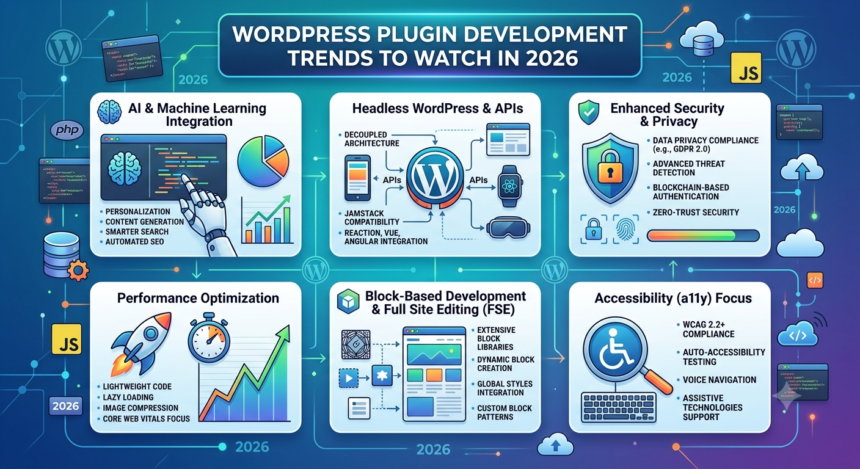
WordPress Plugin Development Trends to Watch in 2026
The Evolving WordPress Ecosystem in 2026
Modern web development is no longer about stacking basic PHP scripts. The future of wordpress plugins revolves around headless setups, automated workflows, and tight component integration. Enterprise platforms now demand clean backends paired with React interfaces. Forward-thinking businesses must look beyond legacy tools and adopt flexible architectures.
Key Plugin Development Trends for 2026
1. Embedded AI & Machine Learning Workflows
Smart tools are moving away from external scripts toward direct AI/LLM integration inside the dashboard. Today, ai plugin development wordpress focuses on localized predictive tools and content tagging. These systems process data using serverless backend setups to minimize overhead. Does every platform need predictive models? Not necessarily, but high-traffic ecommerce sites gain a distinct edge.
2. Block-First Native Plugins (Full-Site Editing Ecosystem)
Legacy shortcodes are obsolete across professional web properties. Modern block-based wordpress plugins use native React components for fast rendering and simple editing. Content teams customize layouts without editing raw code or breaking site styling. Engineers focus on modular code, ensuring blocks load assets only when rendered.
3. Headless-Ready and Decoupled Architecture
Decoupled setups continue reshaping how brands publish content everywhere. Technical teams prioritize headless wordpress plugin development that exposes clean REST API and GraphQL endpoints. This approach allows fast content distribution to web applications and mobile apps. Working with wordpress plugin development services helps businesses bridge legacy CMS logic with modern microservices.
4. Zero-Trust Security Models and Auto-Patching
Automated security measures are replacing traditional reactive monitoring. Modern extension design relies on zero-trust access, continuous validation, and threat isolation. Engineers combine performance optimization with security protocols to keep digital products safe.
Essential features for enterprise extensions include:
- Built-in support for GraphQL and REST API endpoints.
- Isolated React components designed for block editors.
- Automated runtime scanning for immediate threat protection.
- Asynchronous data loading to maximize site performance.
- Direct integration hooks for custom external services.
Preparing Your Business for Next-Gen WordPress Solutions
Upgrading digital infrastructure requires a focused strategy instead of ad-hoc fixes. Teams should evaluate existing tools, eliminate bloated add-ons, and introduce tailored software. Collaborating with technical specialists like Beetweb keeps platforms agile, secure, and ready for future changes.