

The Under-$50 Rule: Kitting Out a Home Without a Renovation Budget
The expensive part of setting up a home is almost never the furniture. It is the forty small things nobody budgets for — the kettle, the fan, the drying rack, the bathroom scale, the second set of towels, the lamp for the corner that turned out to be dark. Individually they are trivial. Together they routinely run past a thousand dollars, and they arrive at exactly the moment when money is tightest: after a move, after a lease signing, after a first mortgage payment.
There is a straightforward way to handle this category, and it starts with refusing to buy any of it at retail.
Sort the list into three piles
Before spending anything, split the shopping list by how much the item’s condition actually matters.
Pile one — condition is irrelevant. Drying racks, storage bins, laundry hampers, shelving brackets, extension cords, doormats. These are shapes made of plastic and metal. A scuff changes nothing. Buy the cheapest sound one you can find and never think about it again.
Pile two — condition matters cosmetically. Lamps, small furniture, kitchen canisters, mirrors, picture frames. Here you care what it looks like from the front, and not at all what it looks like from the back. This is the pile where open-box and lightly used stock produces the largest genuine saving, because you are buying a discount created by a scuff you will never see.
Pile three — condition matters functionally. Anything with a motor, a heating element or a battery. Kettles, fans, blenders, vacuums, space heaters. These are still worth buying discounted, but only with a stated grade and a return window behind them.
Most household lists are 70% pile one and two. That is the part of the budget that should never touch full price.
Where the discount actually comes from
The stock that fills these categories is mostly retail returns and overstock. A carton gets opened, a customer changes their mind, a seasonal line does not sell through — and the unit can no longer be sold as new even though nothing is wrong with it. It re-enters the market graded and repriced.
Canadian retailers working this stream individually rather than by the pallet publish a condition grade against each unit: opened but complete, light wear, visible wear, or as-is where something is missing or untested. Browsing the deals under $50 tier of a liquidation retailer is essentially browsing pile one and pile two of everyone’s moving list, at the point in the supply chain where the packaging rules have already knocked the price down.
The five rules that make this work
1. Buy the boring things first. Storage and organisation items are the highest-volume, lowest-risk purchases on the list, and they compound: an organised closet postpones the purchase of the shelving unit you thought you needed.
2. Never buy a set to get one item. The four-piece bundle at a discount is not cheaper than the one thing you actually wanted at full price if the other three go in a cupboard.
3. Check the return window before the price. Thirty days of returns and free exchanges is what makes buying a graded appliance sensible rather than a gamble. It gives you time to run the thing under real conditions.
4. Read what is missing, not what is included. A good listing names the absent remote, the missing filter, the second charging cable. That single line is the difference between a bargain and a project.
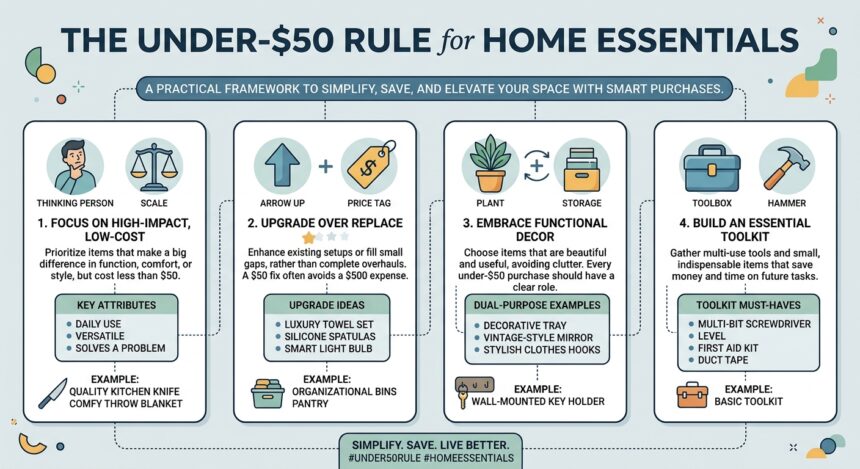
5. Set a per-item ceiling and hold it. Under-$50 works as a discipline because it forces the question “do I need this at all” on precisely the items where the honest answer is sometimes no.
What not to buy this way
Mattresses, car seats and helmets — anything whose safety function degrades invisibly with use or age. Sealed consumables where you cannot confirm the seal. And anything where you would be buying a brand rather than a function; a discounted item you did not want is not a saving.
The bottom line
Furnishing a home is a volume problem disguised as a taste problem. Handle the volume — the forty small things — through graded returns and overstock, hold a per-item ceiling, and read the condition line before the price line. The money left over is what buys the two or three pieces you actually care about.