

A state office or the federal one can certify a document perfectly well and still hand back a certificate the destination has no use for. The package is accepted, the fee taken, and the certificate issued, and the mismatch usually surfaces weeks later, when the file comes back from abroad with a note that the wrong one was attached.
This guide sets out how apostille or embassy legalization is decided, what changes when a record is state rather than federal, and where to confirm the route before anything is posted.
Apostille and Legalization Serve a Similar Purpose
Both procedures answer the same basic question for an official abroad. They provide evidence about the signature on the document, the capacity in which the signer acted, and, where applicable, the seal or stamp it carries. This gives the receiving authority a basis for accepting the document without independently tracing the authentication chain.
Neither procedure generally verifies the content of the paperwork. An authenticated diploma remains the school’s statement about a student, while the authentication or legalization of a contract does not establish the validity of its terms. So document authentication for overseas use speaks to provenance and stops there. Whether a file needs an apostille or legalization, the content of the paper is left to the reader.
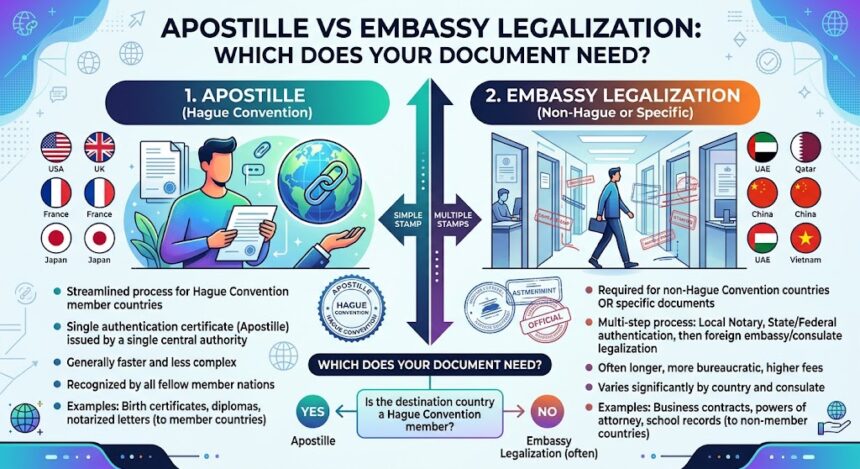
The difference between them starts with the destination country and the authentication route it requires. One route ends with a single certificate issued by the competent authority in the country of origin, while the other continues to the destination country’s own mission.
When an Apostille Is Usually Used
The apostille route applies where the destination belongs to the 1961 Hague Apostille Convention, which the HCCH lists as having 130 Contracting Parties. Within that group, a certificate issued where the document originated is accepted without consular involvement.
Which office issues it depends on where the paper came from. The State Department directs that records signed by federal officials receive an apostille from its Office of Authentications, while a state-issued document is generally apostilled by the competent authority in the state that produced it when the destination is a treaty country.
When Embassy or Consular Legalization May Be Needed
For countries outside the Convention, an apostille carries no standing there, and the file takes a different route. For those destinations, the State Department issues an authentication certificate instead of an apostille for documents that come through its office.
That path usually runs in three stages:
- Certification at the level required for the document, whether that means notarisation, a county clerk’s certificate, or a state’s own certification.
- Government authentication afterward, by the issuing state for its own records or by the Office of Authentications for federal ones.
- Consular legalization at the embassy or consulate that the destination country maintains in the United States, which adds its own certification requirements and processing time.
The requirements of individual missions can differ, since forms, fees, and appointment rules are set according to each mission’s procedures. Anyone filing at those missions regularly — document legalization services among them — may be familiar with the current requirements, but applicants should confirm them.
Non-Hague country legalization also carries a vocabulary problem. The same step appears as embassy authentication on one checklist and embassy certification on another, and the wording used by the mission holding the file is the one worth following.
State, Federal, and Commercial Documents
The route follows the origin because an authority confirms the signature and official capacity within its jurisdiction. Three groups of paperwork come out of that division:
- State-issued records. State document authentication can cover vital records, court records, and locally notarised papers, with the competent authority determined by the state that produced the document.
- Federally signed documents. Federal document authentication covers records signed by federal officials, an FBI background check, or a paper signed by a U.S. consular officer, among others.
- Commercial papers. Powers of attorney, board resolutions, certificates of free sale, and distribution agreements may be notarised by following the applicable state authentication route.
International document processing for a single shipment can involve several of these at once. Sorting them by origin at the start avoids sending a federal record to a state office and having it returned without being processed.
How to Determine the Correct Route
The receiving authority sets the requirement, so the answer comes from abroad rather than from a general rule. Three checks usually settle it before anything is posted:
- Ask the office that will read the document — a university, employer, court, or registry — what it expects and in what form.
- Confirm the destination’s status under the Convention alongside the document type, since the applicable route can differ depending on the type of paperwork and the country where it will be used.
- Read the current instructions of the state office, the Office of Authentications, and the relevant embassy, because fees and processing periods are revised from time to time.
Common Mistakes
Most delays trace back to decisions made before the envelope was sealed. Four errors often recur:
- Sending a document to the wrong authority, such as a federally signed record posted to a state office.
- Assuming an apostille completes a file whose destination expects consular steps afterward.
- Submitting a photocopy or a scan when the authority asks to see the signed and sealed original.
- Booking travel around an estimate, when the Office of Authentications states $20 for each document request and five weeks from receipt, and an embassy adds its own period beyond that.
Timing is one of the errors that can cause the most disruption. Anyone who has to legalize documents for overseas use against a fixed deadline can allow extra time for a possible rejection, which can turn a returned package into an inconvenience instead of a missed appointment.