

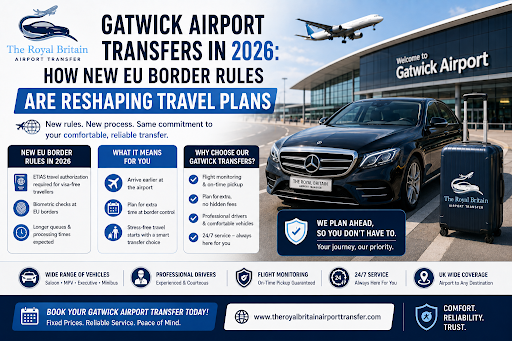
Britons heading to Europe from Gatwick this year are running into a change most didn’t see coming: it isn’t the flight that’s getting slower, it’s the border on the other side of it. Since the EU’s Entry/Exit System (EES) reached full operation across the Schengen Area on 10 April 2026, UK passport holders have reported queues stretching from one to six hours at some of the continent’s busiest crossings. None of this changes how you get through Gatwick itself. But it changes almost everything about how a well-planned Gatwick departure should look — including a detail as simple as how far ahead you book Gatwick Airport transfers, and how much else you leave to chance on the ground.
Why Is 2026 Different for European Travel?
For most of the last decade, a Schengen holiday meant a passport stamp and not much else. That changed when the EU began phasing in EES on 12 October 2025, completing the rollout across all Schengen borders on 10 April 2026. The system replaces manual stamping with digital, biometric registration, and it applies to every UK traveller entering or leaving the Schengen Area for a short stay. Frontex, the EU’s border agency, has told the travel industry it expects disruption to continue for one to two years while member states bring staffing and technology up to speed. That timeline, more than the system itself, is what’s reshaping how experienced travellers are now approaching the trip.
Understanding the EU Entry/Exit System
EES is a digital record of every non-EU traveller’s entries and exits across the Schengen Area’s external borders. On your first crossing after the system applies to you, a border officer takes your fingerprints and a facial scan, links them to your passport, and creates a digital profile — a process that typically takes somewhere between 90 seconds and a few minutes. Later crossings should be quicker, closer to a minute, once your biometric data is already on file. The system also automatically tracks the 90-days-in-180 rule that already limits how long UK visitors can spend in the Schengen Area, removing the need for manual stamp-counting at the border.
It’s worth clearing up a common misunderstanding here: EES doesn’t add anything to check-in or security procedures at Gatwick itself. The extra checks happen at the Schengen border — on arrival in Europe, and again when you leave.
How Border Procedures Affect UK Travellers?
The practical effect lands in two places, and neither of them is Gatwick. The first is on arrival: land in Spain, France, Greece or elsewhere in the Schengen Area, and you’ll likely spend longer at passport control than in previous years, particularly on a first crossing. The second, and the one causing more genuine disruption, is on departure from Europe. Airlines have reported passengers missing return flights after EES exit queues ran longer than expected, including well-documented cases in Milan and Toulouse in 2026 where passengers were still in the border queue when their flight closed. For a UK traveller, that makes the flight home to Gatwick the leg most worth building extra time around, not the flight out.
What Changes for Passengers Flying Through Gatwick?
Gatwick’s own departure process — check-in, security, boarding — is unaffected by EES, since the UK sits outside the Schengen Area. What does change is the shape of the whole journey around it. Airlines and travel bodies, including ABTA, are advising passengers to treat the long-standing two-hour guidance for European flights as a floor rather than a target, and to build extra time into both ends of a Schengen trip. For travellers connecting onward from Gatwick, or catching a same-day return after a short trip, that knock-on effect can turn a comfortable schedule into a tight one — which is exactly where the UK side of the journey, the part actually within your control, starts to matter more.
How Extra Border Checks Can Influence Your Travel Schedule?
Once a delay becomes possible at either end of a Schengen trip, the sensible response is to remove uncertainty everywhere else you can. That means confirming your Gatwick terminal in advance — North and South are separate buildings, linked only by a short shuttle — checking in online where your airline allows it, and increasingly, treating the journey to the airport as something to fix ahead of time rather than leave to chance on the day. A slow EES queue in Faro or Palma isn’t something anyone can control. A pre-arranged, flight-tracked pickup that gets you to Gatwick with margin to spare is.
Planning Your Journey to Gatwick Airport
Getting the wrong terminal is a small but entirely avoidable source of stress at Gatwick — always confirm yours against your actual boarding pass, since airlines do occasionally move between them. Road access runs via the M23 and M25, both prone to unpredictable congestion, particularly during school holidays, when EES-related disruption abroad and peak family travel at home now overlap. For early departures or late arrivals, the margin for error narrows further still, which is part of why more travellers are choosing to fix the ground journey in advance rather than add one more variable to a day that already has enough of them.
Why Do Airport Transfers Matter More Than Ever?
None of this means travellers need to overhaul how they get to the airport — but it does explain why more of them are choosing to fix that part of the journey ahead of time. A pre-booked, flight-tracked transfer removes an entire variable from a trip that increasingly has several: no waiting on a taxi rank, no uncertainty over parking, no risk of a missed connection because a ride wasn’t arranged. Services such as The Royal Britain Airport Transfer’s Gatwick service, which tracks your flight and adjusts pickup times automatically, are built around exactly this kind of predictability — useful in any year, and particularly relevant in one where the rest of the journey has become harder to predict.
Travelling with Children or Large Luggage
Families face a double pressure point in 2026: school holidays already mean Gatwick’s busiest weeks, and EES has added extra unpredictability at the European end for exactly the same period. Children under 12 are exempt from providing fingerprints under EES, though they still pass through the same queues as everyone else, which can test patience on a first crossing. The practical advice for families hasn’t changed so much as been reinforced: build in more time than feels necessary, and don’t add an unpredictable UK-side journey on top of an already unpredictable EU-side one.
Business Travel Considerations
Business travellers work with a narrower margin for error than most, particularly on same-day or tight-connection trips through Schengen hubs. A missed return flight because of an EES exit queue carries real costs beyond the ticket — missed meetings, rebooking fees, lost time. That’s increasing the appeal of predictable, invoiceable ground transport at the Gatwick end of the journey: one less unknown in an itinerary that may already be tighter than it used to be.
Common Mistakes Travellers Should Avoid
The most common mistake in 2026 isn’t ignoring EES — most travellers have heard of it by now — it’s underestimating how it compounds with everything else. Treating the old two-hour guidance as generous rather than minimal, assuming a same-day connection through a Schengen hub is still low-risk, or leaving the journey to Gatwick itself unplanned are always a manageable delay abroad turns into a missed flight home.
Practical Tips Before You Leave Home
Check your specific airline’s current EES guidance rather than relying on general advice, since procedures vary by airport. Confirm your Gatwick terminal against your actual boarding pass. Build extra time into both the outbound arrival and the return departure at your Schengen destination, not just one or the other. Keep travel documents accessible rather than buried in checked luggage. And arrange the one part of the journey that’s entirely predictable — getting to Gatwick — well ahead of time, so it isn’t the thing adding pressure to a day that may already include a longer-than-expected border queue.
Conclusion
EES hasn’t changed anything about Gatwick itself, but it has changed what a well-planned journey through it looks like. With Frontex warning that border disruption could continue for another one to two years, the sensible response isn’t panic — it’s building a little more margin into every stage of the trip, and fixing the parts of the journey that are actually within your control.
FAQ Section
Does the EU Entry/Exit System affect check-in or security at Gatwick Airport?
No. EES applies at Schengen external borders, not UK airports. Gatwick’s own check-in and security procedures are unchanged; the extra registration happens when you land in, and leave, the Schengen Area.
Is ETIAS in effect for UK travellers yet?
No. ETIAS was previously targeted for the last quarter of 2026, but in July 2026 the EU removed that date from its official site, and a 2027 launch is now considered more likely. ETIAS is a separate pre-travel authorisation scheme and shouldn’t be confused with EES, which is already fully operational.
How much extra time should I allow flying from Gatwick to a Schengen country?
Travel bodies including ABTA advise treating the standard two-hour guidance for European flights as a minimum rather than a target, with more time recommended during school holidays and at busier Schengen airports.
Do children need to register for EES?
Children under 12 are exempt from providing fingerprints, though they still pass through the same border queues as other travellers, so processing isn’t necessarily faster for families.
Is my outbound or return flight more likely to be delayed by EES?
Based on 2026 reports so far, return departures from Schengen airports have caused more disruption than arrivals, with some travellers missing scheduled flights home after long exit queues.
Does EES apply to travel by rail or ferry, not just flights?
Yes, EES applies at Schengen external borders regardless of transport mode. Some UK rail and ferry terminals host juxtaposed French border control, meaning registration can happen on UK soil for those specific routes — this differs from flying via Gatwick, where checks happen only on arrival in the EU.
Is it still worth booking a private transfer to Gatwick if the delays happen abroad, not in the UK?
Yes — because EES-related delays are outside your control, removing uncertainty from the parts of the trip you can control, including the journey to the airport, lowers the overall risk of the day going wrong.