

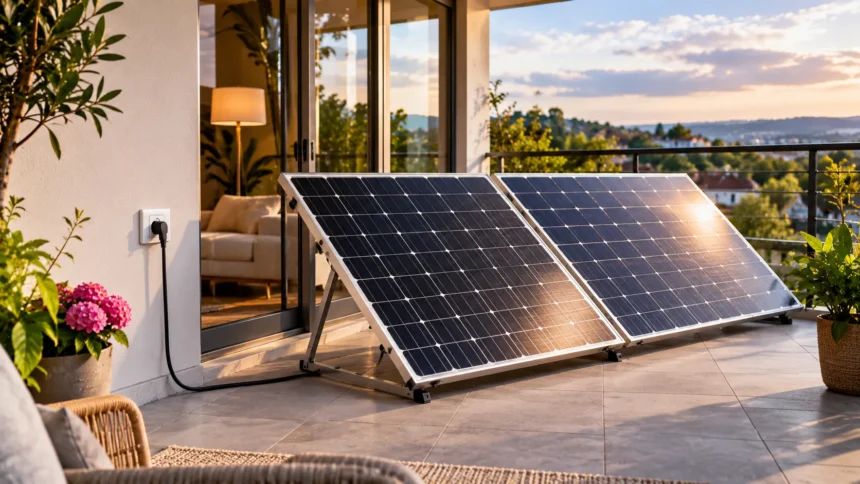
Your electricity bill arrives, and once again, it is higher than you expected. Installing a traditional rooftop solar system sounds appealing, but the upfront costs, property requirements, and installation process make you hesitate. Is there a simpler way to benefit from solar energy without making a major investment?
Plug-in solar panels offer an alternative for households looking to generate a smaller amount of renewable electricity. These compact systems are particularly attractive to apartment residents, renters, and homeowners who cannot accommodate traditional rooftop solar installations.
But are plug-in solar panels worth the investment? Understanding their energy production, potential savings, safety requirements, and limitations can help you make an informed decision. This guide explains everything you need to know before considering this renewable energy option.
What Are Plug-In Solar Panels?
Traditional solar installations often require considerable roof space, professional planning, and a substantial financial commitment. These requirements can make renewable energy feel inaccessible to people living in smaller properties or rented apartments.
Plug-in solar panels are compact photovoltaic systems designed to generate electricity from sunlight and supply it to a compatible household electrical system. They are sometimes called balcony solar panels, mini solar systems, or plug-in photovoltaic systems.
Unlike larger rooftop installations, these systems generally produce smaller amounts of electricity. Their primary purpose is to offset a portion of household energy consumption rather than meet the entire property’s electricity requirements.
How Do Plug-In Solar Panels Work?
Solar technology can seem complicated when you are unfamiliar with electrical systems. However, the basic principle behind plug-in solar power is similar to that of conventional photovoltaic technology.
Solar panels capture sunlight and convert it into direct current electricity, commonly known as DC electricity. A microinverter converts this electricity into alternating current, or AC electricity, which is compatible with household electrical systems.
When a compliant system supplies electricity to a household, it can reduce the amount of energy purchased from the utility provider. Actual savings depend on how much solar electricity the household uses and whether excess generation receives compensation.
The main components generally include:
- Photovoltaic solar panels.
- A compatible microinverter.
- Certified electrical connection equipment.
- Suitable mounting structures.
- Electrical safety protections.
- Optional energy monitoring features.
Although the technology is relatively compact, electrical compatibility and regulatory compliance remain essential. These systems should never be treated as ordinary household appliances without checking their specific safety requirements.
Plug-In Solar Panels vs. Traditional Solar Panels
Choosing between traditional rooftop solar and a smaller plug-in system can be difficult. Both technologies generate renewable electricity, but they are designed for different energy requirements and property conditions.
Traditional solar systems generally provide greater electricity production and long-term savings potential. Plug-in systems offer a smaller-scale alternative for households unable to accommodate larger installations.
| Feature | Plug-In Solar Panels | Traditional Solar Panels |
|---|---|---|
| System size | Small and compact | Larger installation |
| Initial investment | Generally lower | Generally higher |
| Energy production | Limited | Significantly higher |
| Space requirements | Relatively small | Usually requires substantial roof space |
| Portability | Some systems are portable | Usually permanent |
| Installation requirements | Product and location dependent | Professional installation |
| Battery storage | Optional in compatible systems | Available with compatible systems |
| Electricity savings | Partial household savings | Potentially substantial savings |
| Best suited for | Smaller energy requirements | Broader household energy requirements |
The better option depends on your property, electricity consumption, budget, and local regulations. Smaller systems should not be expected to perform like full-sized rooftop installations.
8 Benefits of Plug-In Solar Panels
Investing in renewable energy can feel overwhelming when traditional installations exceed your available budget. Plug-in solar systems provide an opportunity to explore solar energy on a smaller scale.
Their compact design and relatively modest energy production make them appealing to certain households. However, their benefits depend on suitable property conditions and compliant equipment.
Here are eight potential advantages of plug-in solar panels.
1. Lower Initial Investment
Traditional rooftop solar installations can involve significant equipment, labor, and infrastructure expenses. These costs may discourage households from exploring renewable energy altogether.
Plug-in solar systems generally require a smaller initial investment because they contain fewer panels and less equipment. This can make them a more accessible option for households with limited budgets.
Nevertheless, consider the complete cost, including professional electrical assessments, permissions, mounting requirements, and any necessary property modifications.
2. Potential Reduction in Electricity Bills
Rising electricity prices can make household budgeting increasingly difficult. Even modest energy savings may become valuable when electricity costs remain high over several years.
Plug-in solar panels can offset some electricity that would otherwise be purchased from the grid. The financial benefit is generally greater when household energy consumption overlaps with solar electricity generation.
Savings vary considerably according to sunlight exposure, electricity rates, system efficiency, and energy consumption patterns. No system can guarantee identical savings for every household.
3. Suitable for Properties With Limited Space
Many apartment residents do not have access to a private roof. This limitation makes traditional solar installations impractical, even when residents are interested in renewable energy.
Compact solar systems may be suitable for certain balconies, terraces, gardens, and other approved outdoor spaces. Their smaller footprint makes them worth evaluating for properties with limited installation areas.
However, not every balcony or outdoor space is suitable. Structural safety, sunlight exposure, building regulations, and property permissions must be considered.
4. Supports Renewable Energy Generation
Electricity generated from fossil fuels can contribute to greenhouse gas emissions. Many households want to reduce their environmental impact but struggle to find practical alternatives.
Solar panels generate electricity from sunlight without directly burning fuel during operation. Even smaller systems can contribute to renewable electricity generation when used under suitable conditions.
Solar equipment still has environmental impacts associated with manufacturing, transportation, and disposal. Its overall environmental benefits depend partly on its lifespan, performance, and the electricity it replaces.
5. Greater Flexibility for Certain Renters
Renting a property can limit your ability to make permanent modifications. Investing in a conventional rooftop installation may not be practical when you expect to move in the future.
Some compact solar products are designed to be relatively portable. This flexibility may be attractive to tenants who want to explore renewable energy without committing to a permanent installation.
Renters must still obtain appropriate permissions and comply with lease agreements. Portability does not remove electrical, structural, or building safety requirements.
6. Reduced Daytime Grid Electricity Consumption
Households often use electricity throughout the day, even when nobody is actively operating large appliances. Refrigerators, routers, and other devices contribute to ongoing energy consumption.
A properly designed plug-in solar system may offset some of this daytime electricity demand. Its contribution depends on the amount of sunlight available and the property’s electricity consumption.
Grid electricity remains necessary whenever household demand exceeds solar generation. These systems provide supplementary energy rather than complete independence from the utility network.
7. Opportunity to Understand Household Energy Use
Understanding electricity consumption can be challenging when your monthly bill only provides an overall total. Many people are unaware of how their daily routines affect energy demand.
Some plug-in solar products include monitoring features that display electricity generation over time. This information can help households better understand seasonal changes and the relationship between energy production and consumption.
However, generation monitoring does not automatically measure total household savings. Comparing actual electricity purchases and energy consumption provides a more complete picture.
8. A Smaller Commitment to Solar Energy
Investing in a complete solar installation may feel like a major decision when you are unfamiliar with renewable energy technology. Smaller systems offer another way to evaluate whether solar energy suits your property.
Households can observe how sunlight availability, weather conditions, and electricity consumption influence solar performance. These insights may support future decisions about larger renewable energy investments.
However, smaller systems are not automatically suitable for expansion. Any future changes must comply with applicable electrical requirements and equipment limitations.
What Are the Disadvantages of Plug-In Solar Panels?
Although plug-in solar panels offer several benefits, they are not suitable for every household. Overlooking their limitations can lead to disappointing electricity savings and unnecessary expenses.
Their relatively small capacity means they cannot usually meet the energy requirements of an entire home. Environmental conditions and regulatory restrictions may further limit their usefulness.
Common disadvantages include:
- Limited electricity generation.
- Reduced output during cloudy weather.
- No solar generation at night.
- Potential building and landlord restrictions.
- Electrical compatibility requirements.
- Variable financial savings.
- Limited suitability for energy-intensive households.
- Possible additional professional assessment costs.
- No automatic backup power during electricity outages.
Understanding these limitations helps establish realistic expectations before making a financial commitment.
How Much Electricity Can Plug-In Solar Panels Generate?
One of the most common questions about plug-in solar systems concerns their electricity production. Advertised power ratings can create unrealistic expectations when shoppers assume panels generate maximum power throughout the day.
Solar panel capacity is measured in watts, while the amount of electricity generated over time is measured in kilowatt-hours. Actual production depends on sunlight, temperature, shading, panel orientation, and system efficiency.
The following table provides hypothetical daily generation estimates under different effective sunlight conditions, before additional system losses.
| System Capacity | 3 Effective Sunlight Hours | 5 Effective Sunlight Hours |
|---|---|---|
| 200 watts | 0.6 kWh | 1 kWh |
| 400 watts | 1.2 kWh | 2 kWh |
| 600 watts | 1.8 kWh | 3 kWh |
| 800 watts | 2.4 kWh | 4 kWh |
These figures are illustrative rather than guaranteed production estimates. Actual generation may be lower because of environmental conditions, inverter limitations, and equipment losses.
System capacities must also comply with local regulations. An advertised panel rating does not automatically mean the equipment is authorized for household grid connection.
How Much Do Plug-In Solar Panels Cost?
The advertised price of a solar kit may seem affordable, but it does not necessarily represent the complete investment. Additional equipment, professional assessments, and property requirements can increase overall expenses.
Plug-in solar panel prices vary considerably between countries, manufacturers, system capacities, and certification requirements. Battery storage and advanced monitoring features may also increase the upfront cost.
When evaluating the total investment, consider:
- Solar panel and microinverter costs.
- Certified mounting equipment.
- Professional electrical assessment expenses.
- Required property permissions.
- Any necessary electrical upgrades.
- Optional energy monitoring features.
- Maintenance and potential replacement costs.
- Compatible battery storage, if applicable.
Compare complete ownership costs rather than focusing exclusively on the advertised kit price. A cheaper system may become more expensive if it requires substantial additional work.
How Much Money Can Plug-In Solar Panels Save?
Purchasing solar equipment without estimating potential savings can lead to financial disappointment. A system that performs well in one household may provide considerably less value in another.
Electricity savings depend primarily on how much solar energy you generate and use within your household. Higher electricity prices can improve financial returns, while limited sunlight and low daytime consumption may reduce them.
Consider these hypothetical annual savings scenarios, based on an electricity rate of $0.25 per kilowatt-hour.
| Solar Electricity Used Annually | Illustrative Annual Savings |
|---|---|
| 200 kWh | $50 |
| 400 kWh | $100 |
| 600 kWh | $150 |
| 800 kWh | $200 |
These examples assume the listed electricity directly replaces purchased energy. They exclude fixed utility charges, maintenance costs, and compensation for electricity exported to the grid.
Your actual savings will depend on your electricity tariff and local energy policies. Avoid relying on marketing claims that do not explain their underlying assumptions.
How Long Do Plug-In Solar Panels Take to Pay for Themselves?
Understanding the financial return is important when deciding whether renewable energy equipment is worth purchasing. A lower initial price does not necessarily guarantee a faster return on investment.
The payback period represents the approximate time required for accumulated electricity savings to recover the initial investment. Equipment costs, annual savings, and maintenance expenses all influence this calculation.
For example, a hypothetical system costing $600 and saving $100 annually would have a simple payback period of six years, excluding additional expenses.
| Total System Cost | Annual Savings | Simple Payback Period |
|---|---|---|
| $400 | $100 | 4 years |
| $600 | $100 | 6 years |
| $800 | $100 | 8 years |
| $1,000 | $100 | 10 years |
Actual payback periods can change as electricity prices, equipment performance, and maintenance requirements evolve. Consider expected property occupancy and product lifespan before evaluating long-term returns.
Are Plug-In Solar Panels Safe?
The convenience suggested by the term plug-in solar can sometimes create misleading expectations. Unlike ordinary appliances that consume electricity, grid-connected solar equipment supplies electricity to a property’s electrical system.
Unsuitable equipment, incompatible wiring, and inadequate electrical protections can create risks, including overheating, electrical shock, and fire. Improperly secured outdoor panels can also present structural hazards during strong winds.
Important safety considerations include:
- Verified certification for the complete solar system.
- Compatibility with the property’s electrical infrastructure.
- Appropriate protection during grid outages.
- Suitable weather resistance.
- Professional assessment of mounting safety.
- Compliance with applicable electrical regulations.
- Authorization from relevant property owners and electricity providers.
Never improvise a connection, modify electrical components, or bypass protective equipment. A qualified electrician should assess electrical compatibility and determine whether the proposed system is appropriate for the property.
Are Plug-In Solar Panels Legal?
Purchasing a solar product online does not automatically mean it is legal to connect it to your home’s electricity supply. Regulations vary between countries, states, municipalities, and utility providers.
Germany has established specific provisions for small balcony solar systems, including simplified registration arrangements for qualifying equipment. Great Britain introduced regulatory changes in August 2026 permitting compliant plug-in solar products under defined requirements.
In the United States, several states have introduced legislation supporting small plug-in solar systems. However, authorization, certification requirements, implementation dates, and local electrical rules differ by jurisdiction.
| Region | General Regulatory Situation |
|---|---|
| Germany | Established framework for qualifying balcony solar systems |
| Great Britain | Compliant devices permitted under specific requirements |
| United States | Rules vary by state, locality, and utility provider |
| Other countries | Subject to national and local electrical regulations |
Before making a purchase, consult the relevant energy regulator, utility provider, property owner, and qualified electrical professional. Regulations continue to evolve, making current verification essential.
Can Plug-In Solar Panels Power an Entire House?
Households searching for lower electricity bills may hope a compact solar system can replace their existing electricity supply. Unfortunately, most plug-in systems are designed to provide supplementary energy rather than whole-home power.
Large appliances, electric heating systems, air conditioners, and other energy-intensive equipment can require considerably more electricity than a small solar system generates. Household demand also changes throughout the day.
Plug-in solar panels may offset a portion of everyday electricity consumption under favorable conditions. Households seeking substantial energy independence should consider professionally designed rooftop solar or other suitable renewable energy systems.
Do Plug-In Solar Panels Work During Power Outages?
Electricity outages can leave homeowners searching for reliable backup power. However, ordinary grid-connected plug-in solar panels generally cannot supply electricity when the utility grid is unavailable.
Compliant grid-connected inverters typically stop supplying electricity during an outage through a safety feature known as anti-islanding protection. This helps prevent unintended electrical energization and protects people working on the electricity network.
Backup electricity requires equipment specifically designed and approved for independent operation. A qualified solar professional can explain suitable battery storage or backup power options.
Plug-In Solar Panels vs. Portable Solar Power Stations
Portable solar power stations and plug-in solar systems are sometimes confused because both use relatively compact solar equipment. However, their purposes and operating principles are different.
A grid-connected plug-in solar system is designed to offset household electricity consumption. A portable solar power station generally stores electricity in a battery and supplies compatible devices independently.
| Feature | Plug-In Solar System | Portable Power Station |
|---|---|---|
| Primary purpose | Reduce grid electricity consumption | Portable or backup electricity |
| Battery storage | Not always included | Generally included |
| Grid connection | Requires an authorized arrangement | Generally independent |
| Power during outages | Usually unavailable | Available within device limitations |
| Electricity bill savings | Potentially measurable | Depends on usage |
| Typical application | Supplementary household energy | Portable device charging and backup |
Choose between these technologies according to your actual energy requirements. Neither should be connected to household wiring outside its approved operating conditions.
What Factors Affect Plug-In Solar Panel Performance?
Two households can purchase similar solar products and experience noticeably different results. This happens because environmental conditions and electricity consumption influence solar performance.
A property with consistent sunlight may generate significantly more electricity than one surrounded by tall buildings or trees. Seasonal weather changes can also affect annual production.
Important performance factors include:
- Local sunlight availability.
- Shading from nearby buildings.
- Seasonal weather patterns.
- Panel orientation.
- Solar panel efficiency.
- Inverter performance.
- Equipment condition.
- Household daytime electricity consumption.
A professional solar assessment can help identify whether the property’s conditions support meaningful electricity generation. This is particularly valuable for apartments with limited outdoor space.
Who Should Consider Plug-In Solar Panels?
Not every household needs the same renewable energy solution. A compact system may provide reasonable value for one property while offering very limited benefits for another.
Plug-in solar panels may appeal to households interested in supplementary renewable electricity without investing in a full rooftop installation. Properties with suitable outdoor space, favorable sunlight, and compatible electrical infrastructure are generally better candidates.
They may be worth evaluating for:
- Homeowners with limited roof space.
- Apartment residents with suitable property permissions.
- Renters exploring approved renewable energy options.
- Households with regular daytime electricity consumption.
- Properties receiving consistent sunlight.
- People interested in smaller-scale solar investments.
However, suitability should always be confirmed through appropriate professional assessment rather than assumptions based on property type alone.
Are Plug-In Solar Panels Worth It?
The answer depends on your financial expectations, electricity consumption, property conditions, and local regulations. These systems can provide useful supplementary electricity, but they are not a universal solution to rising energy costs.
A compliant system may offer reasonable value when it receives adequate sunlight, offsets meaningful household consumption, and has manageable total ownership costs. Poor sunlight, expensive electrical upgrades, or limited daytime electricity use may weaken the financial return.
Before deciding, consider three important questions:
- Can the system be legally and safely accommodated at your property?
- How much electricity could it realistically offset each year?
- Will the expected savings justify the complete investment?
If the answers are favorable, plug-in solar may be worth considering. Otherwise, community solar programs, energy-efficient appliances, or professionally designed conventional solar systems may provide better alternatives.
Frequently Asked Questions
1. Do plug-in solar panels really reduce electricity bills?
Yes, compliant plug-in solar systems may reduce electricity purchases by supplying supplementary renewable energy. Actual savings depend on sunlight, system capacity, electricity prices, and household consumption.
2. Can you use plug-in solar panels in an apartment?
Some apartments may accommodate approved balcony solar systems. However, landlord permission, structural suitability, electrical compatibility, and compliance with local regulations must be confirmed beforehand.
3. Do plug-in solar panels work on cloudy days?
Yes, solar panels can generate electricity from diffuse sunlight during cloudy weather. However, their output is generally lower than during favorable sunny conditions.
4. Do plug-in solar panels need batteries?
Not necessarily. Standard grid-connected systems can operate without batteries. Compatible energy storage may provide additional functionality but increases costs and requires appropriate safety approvals.
5. How long do plug-in solar panels last?
Quality photovoltaic panels can remain productive for 20 years or longer. However, microinverters and other components may have shorter lifespans, making product warranties and equipment quality important considerations.
Conclusion
Plug-in solar panels provide an interesting opportunity for households looking to explore renewable energy on a smaller scale. Their compact design, relatively modest investment, and potential electricity savings make them appealing alternatives to traditional rooftop installations.
However, their value depends on realistic energy expectations, property suitability, electrical safety, and regulatory compliance. They cannot usually power an entire household or provide automatic backup electricity during outages.
Start by reviewing your electricity bills and arranging a professional assessment of your property’s solar potential. Compare realistic annual savings against total ownership costs before making a decision. A well-informed approach can help you determine whether plug-in solar is genuinely worth the investment.