
Supply chain management is one of the most important functions in modern business. Every product people buy, from a mobile phone and a packet of food to a car or a piece of furniture, passes through a series of connected activities before reaching the final customer. These activities may include obtaining raw materials, manufacturing products, storing inventory, transporting goods, processing orders, and managing customer returns.
Supply chain management coordinates all these activities so that products and services move efficiently from suppliers to customers. It connects businesses, manufacturers, distributors, retailers, logistics providers, technology systems, and consumers.
In a highly competitive global economy, effective supply chain management can reduce costs, improve product availability, strengthen customer satisfaction, and protect a company from disruption. Poor supply chain management, however, can lead to shortages, delays, damaged products, excessive inventory, and financial losses.
What Is Supply Chain Management?
Supply chain management, commonly known as SCM, is the planning, coordination, and control of the flow of goods, services, information, and money from the initial supplier to the final customer.
A supply chain begins before a product is manufactured. It often starts with the sourcing of raw materials and continues through production, packaging, storage, transportation, distribution, sales, and after-sales service.
For example, the supply chain of a laptop may involve companies that supply metals, glass, processors, batteries, memory chips, screens, packaging materials, and software. These components may come from several countries before being assembled in a factory. The finished laptop is then transported to warehouses, retailers, or customers.
Supply chain management ensures that each stage works together as efficiently as possible.
The Main Components of a Supply Chain
A modern supply chain usually contains several interconnected components. Each component affects the cost, speed, quality, and reliability of the final product.
Planning
Planning is the foundation of supply chain management. Businesses must estimate customer demand, determine how much inventory to maintain, schedule production, and allocate resources.
Accurate planning helps companies avoid two major problems: having too much stock and having too little stock.
Excess inventory increases storage and insurance costs and may result in outdated or expired products. Insufficient inventory can cause stockouts, lost sales, and dissatisfied customers.
Supply chain planners use historical sales data, seasonal trends, market conditions, customer behaviour, and forecasting tools to estimate future demand.
Sourcing
Sourcing involves selecting suppliers that provide raw materials, components, services, or finished goods.
Businesses evaluate suppliers based on factors such as:
- Price
- Product quality
- Delivery reliability
- Production capacity
- Financial stability
- Ethical standards
- Environmental performance
- Geographic location
Supplier selection is not based only on the lowest price. A low-cost supplier may create greater expenses if deliveries are frequently delayed or materials fail to meet quality standards.
Strong supplier relationships can improve communication, reduce risk, and support long-term business growth.
Procurement
Procurement refers to the process of purchasing the materials and services required by an organisation. It includes negotiating contracts, placing orders, approving invoices, monitoring supplier performance, and managing payment terms.
Sourcing and procurement are closely related, but they are not exactly the same. Sourcing focuses on identifying and selecting suppliers, while procurement manages the actual purchasing process.
Effective procurement helps businesses control spending and obtain the right materials at the right time.
Manufacturing and Production
The manufacturing stage converts raw materials or components into finished products.
Supply chain managers work with production teams to determine:
- What should be produced
- How much should be produced
- When production should begin
- Which equipment and workers are required
- How quality will be monitored
- Where finished goods will be stored
Production efficiency affects the entire supply chain. Equipment breakdowns, labour shortages, quality problems, or material delays can interrupt operations and delay customer orders.
Inventory Management
Inventory includes raw materials, work-in-progress items, and finished products.
Inventory management aims to maintain enough stock to meet customer demand without creating unnecessary storage costs.
Businesses use different inventory strategies depending on their products and markets. Some maintain large safety stocks to protect against uncertainty. Others use lean inventory systems and receive materials only when they are needed.
Inventory decisions are especially important for perishable food, medicine, seasonal products, fashion items, and technology products that can quickly become outdated.
Warehousing
Warehousing involves storing goods safely until they are required for production, distribution, or sale.
Modern warehouses perform more than basic storage. They may also handle:
- Product sorting
- Packaging
- Labelling
- Order picking
- Quality inspection
- Inventory tracking
- Returns processing
Warehouse design can significantly affect delivery speed. Frequently ordered products are often stored close to packing and dispatch areas, while slower-moving products may be placed farther away.
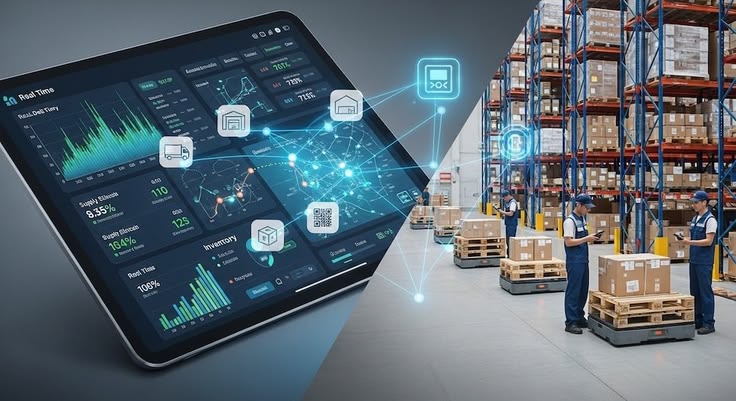
Automation, barcode systems, robots, and warehouse management software are increasingly used to improve accuracy and productivity.
Transportation and Logistics
Transportation moves materials and products between suppliers, factories, warehouses, retailers, and customers.
Goods may be transported by road, rail, air, sea, or a combination of methods. The best method depends on cost, delivery urgency, product type, distance, and destination.
Air freight is fast but expensive. Sea freight is generally more economical for large international shipments but takes longer. Road transportation offers flexibility, while rail can be effective for heavy goods over long distances.
Logistics management ensures that products are delivered safely, efficiently, and on schedule.
Distribution
Distribution focuses on getting finished products to the market.
A company may distribute products directly to customers or use intermediaries such as wholesalers, distributors, retailers, and online marketplaces.
The distribution model affects delivery time, product availability, pricing, and customer experience.
For example, an online business may send orders directly from a central warehouse. A supermarket supplier may deliver products to regional distribution centres before they are sent to individual stores.
Order Fulfilment
Order fulfilment begins when a customer places an order and ends when the product is successfully delivered.
The process usually includes:
- Receiving the order
- Confirming payment
- Checking inventory
- Picking the product
- Packing the order
- Arranging shipment
- Providing tracking information
- Completing delivery
Fast and accurate fulfilment is especially important in e-commerce, where customers expect clear communication and reliable delivery dates.
Returns and Reverse Logistics
Supply chains do not always end when products reach customers. Some goods are returned because they are defective, damaged, unwanted, or incorrectly delivered.
Reverse logistics manages the movement of returned goods from customers back to the seller, warehouse, manufacturer, recycler, or repair centre.
Returned products may be refunded, repaired, resold, recycled, or disposed of.
An efficient returns process can improve customer trust and recover value from products that might otherwise become waste.
How Supply Chain Management Creates Business Value
Supply chain management supports several major business objectives.
Reducing Operating Costs
Efficient supply chains reduce waste, transportation expenses, storage costs, production delays, and unnecessary inventory.
Even a small improvement in delivery routes, inventory accuracy, packaging, or supplier pricing can generate significant savings when applied across thousands of transactions.
Improving Customer Satisfaction
Customers expect products to be available, delivered on time, and received in good condition.
Supply chain performance directly affects these expectations. A business may have excellent advertising and a high-quality product, but customers will still be dissatisfied if orders arrive late or unavailable items are repeatedly advertised.
Reliable supply chains strengthen customer confidence and encourage repeat purchases.
Supporting Business Growth
A company cannot expand effectively if its supply chain cannot handle additional demand.
When entering new markets, launching products, or opening new locations, businesses must ensure that suppliers, warehouses, technology, employees, and transportation networks can support increased volume.
Supply chain planning makes growth more organised and sustainable.
Improving Product Quality
Quality management begins with suppliers and continues throughout production, storage, transportation, and delivery.
Poor-quality raw materials can affect finished products. Incorrect warehouse temperatures can damage food or medicine. Inadequate packaging can result in breakage during transportation.
Supply chain controls help businesses identify and prevent quality problems at every stage.
Strengthening Competitive Advantage
A well-managed supply chain can become a major competitive advantage.
Some businesses compete through lower prices, while others compete through faster delivery, better product availability, customisation, reliability, or sustainability.
Companies with efficient supply chains can respond more quickly to market changes and serve customers more effectively than competitors.
The Role of Technology in Supply Chain Management
Technology has transformed supply chain operations. Businesses can now collect, analyse, and share information across multiple locations in real time.
Enterprise Resource Planning Systems
Enterprise resource planning systems connect business functions such as purchasing, finance, inventory, manufacturing, and sales.
These systems create a central source of information, allowing departments to work with consistent data.
For example, when a customer order is entered, the system may automatically update inventory levels, production schedules, financial records, and delivery requirements.
Warehouse Management Systems
Warehouse management systems control the movement and storage of goods inside warehouses.
They help workers locate products, manage stock levels, process orders, and reduce picking errors.
Advanced systems may direct employees through the most efficient route in the warehouse or coordinate robotic equipment.
Transportation Management Systems
Transportation management systems help businesses plan shipments, select carriers, calculate routes, compare costs, and monitor deliveries.
These systems can improve vehicle utilisation and reduce fuel consumption by combining compatible shipments and avoiding inefficient routes.
Internet of Things Devices
Internet of Things devices use sensors to collect and transmit information.
In supply chains, sensors can monitor:
- Product temperature
- Humidity
- Vehicle location
- Equipment condition
- Delivery status
- Warehouse activity
This is particularly valuable for food, pharmaceuticals, chemicals, and other products that must remain within specific environmental conditions.
Artificial Intelligence and Predictive Analytics
Artificial intelligence can analyse large amounts of supply chain data and identify patterns that may be difficult for people to detect.
It can support demand forecasting, supplier risk assessment, route planning, equipment maintenance, inventory optimisation, and fraud detection.
Predictive analytics helps businesses prepare for future conditions rather than reacting only after problems occur.
Blockchain
Blockchain technology can create secure and traceable records of supply chain transactions.
It may be used to verify product origins, confirm ownership transfers, track shipments, and improve transparency.
For example, blockchain records can help confirm whether food products, luxury goods, minerals, or pharmaceutical products came from approved sources.
Global Supply Chains
Many modern supply chains operate across several countries.
A product may be designed in one country, manufactured in another, packaged elsewhere, and sold in multiple international markets.
Global supply chains offer several benefits. Companies may gain access to specialised skills, lower production costs, larger supplier networks, and new customer markets.
However, they also create additional complexity.
Businesses must manage:
- Customs procedures
- Import and export regulations
- Currency fluctuations
- International taxes
- Language differences
- Political instability
- Long transportation distances
- Different labour and environmental standards
A disruption in one region can affect companies and customers around the world.
Common Supply Chain Risks
Supply chains face many types of risk. Businesses must identify these risks and prepare suitable responses.
Supplier Failure
A supplier may fail because of financial problems, labour disputes, equipment breakdowns, material shortages, or natural disasters.
Companies that depend on a single supplier are especially vulnerable.
To reduce risk, businesses may approve alternative suppliers, maintain emergency inventory, or source materials from different geographic regions.
Transportation Disruption
Ports, airports, roads, railways, and shipping routes may be affected by bad weather, accidents, congestion, strikes, conflict, or infrastructure failure.
Businesses can reduce transportation risk by using alternative routes, multiple carriers, and better shipment visibility.
Demand Uncertainty
Customer demand is not always predictable.
Unexpected trends, competitor actions, weather patterns, economic conditions, or social media attention can create sudden increases or decreases in demand.
Improved forecasting and flexible production systems help businesses respond more effectively.
Cybersecurity Threats
Modern supply chains depend heavily on digital systems.
Cyberattacks can interrupt production, steal business data, block access to logistics platforms, and disrupt communication with suppliers.
Supply chain cybersecurity requires secure systems, employee training, access controls, backups, monitoring, and clear incident-response plans.
Quality Failures
Defective materials or poor production processes can result in product recalls, customer complaints, legal claims, and reputational damage.
Businesses need supplier audits, inspections, testing procedures, and traceability systems to identify where problems occurred.
Geopolitical and Regulatory Risk
Trade restrictions, tariffs, sanctions, political conflict, and regulatory changes can affect the movement and cost of goods.
Companies operating internationally must monitor legal and political developments and avoid excessive dependence on high-risk markets.
Supply Chain Resilience
Supply chain resilience is the ability to prepare for, respond to, and recover from disruption.
A resilient supply chain is not necessarily the cheapest possible supply chain. It balances efficiency with flexibility and risk protection.
Resilience strategies may include:
- Using multiple suppliers
- Holding safety stock
- Developing alternative transport routes
- Locating production closer to customers
- Improving data visibility
- Creating emergency response plans
- Maintaining backup technology systems
- Training employees for operational disruptions
The goal is to continue serving customers even when normal operations are interrupted.
Lean Supply Chain Management
Lean supply chain management focuses on reducing waste.
Waste may include excess inventory, unnecessary movement, overproduction, defects, delays, and inefficient processes.
A lean supply chain attempts to use fewer resources while maintaining quality and customer service.
Common lean principles include continuous improvement, standardised processes, accurate demand planning, and close supplier coordination.
However, extremely lean supply chains can become vulnerable if they have no reserve capacity or safety stock. Businesses must balance efficiency with resilience.
Agile Supply Chain Management
Agile supply chains are designed to respond quickly to changes in customer demand and market conditions.
Agility is especially important in industries such as fashion, consumer electronics, online retail, and seasonal products.
Agile supply chains often use flexible manufacturing, real-time data, rapid supplier communication, and shorter planning cycles.
A business may combine lean and agile methods. It can use lean processes for stable products and agile processes for unpredictable or fast-changing products.
Sustainable Supply Chain Management
Sustainability has become an important supply chain priority.
A sustainable supply chain aims to reduce negative environmental and social impacts while maintaining commercial performance.
Environmental initiatives may include:
- Reducing packaging
- Improving fuel efficiency
- Using renewable energy
- Recycling materials
- Reducing water consumption
- Lowering greenhouse gas emissions
- Designing products for reuse or repair
Social responsibility may involve fair wages, safe working conditions, ethical sourcing, and preventing forced labour or child labour.
Businesses are increasingly expected to understand not only their own operations but also the conduct of their suppliers.
Green Logistics
Green logistics focuses specifically on reducing the environmental impact of transportation, warehousing, and distribution.
Companies may use electric delivery vehicles, optimise routes, combine shipments, improve vehicle loading, reduce empty journeys, and design smaller packaging.
Warehouses may use solar energy, efficient lighting, insulation, and energy-management systems.
These measures can reduce both environmental impact and operating costs.
The Bullwhip Effect
The bullwhip effect occurs when small changes in customer demand create increasingly large changes further up the supply chain.
For example, a small increase in retail sales may cause a retailer to place a larger order with a distributor. The distributor may then place an even larger order with a manufacturer, which orders excessive raw materials from suppliers.
This can result in overproduction, excess inventory, shortages, and unstable production schedules.
The bullwhip effect can be reduced through better information sharing, accurate demand data, smaller order quantities, shorter lead times, and closer coordination between supply chain partners.
Important Supply Chain Performance Measures
Businesses use performance indicators to evaluate supply chain effectiveness.
Order Accuracy
Order accuracy measures how often customers receive the correct products and quantities.
On-Time Delivery
On-time delivery measures the percentage of orders delivered by the promised date.
Inventory Turnover
Inventory turnover measures how quickly inventory is sold and replaced.
Low turnover may indicate excessive stock, while extremely high turnover may increase the risk of shortages.
Order Cycle Time
Order cycle time measures the time between receiving an order and delivering it to the customer.
Fill Rate
Fill rate shows how much customer demand can be met immediately from available inventory.
Supply Chain Cost
Supply chain cost includes procurement, production, warehousing, transportation, inventory, technology, and returns expenses.
Perfect Order Rate
The perfect order rate measures orders that are delivered on time, complete, damage-free, and with correct documentation.
The Role of Supply Chain Managers
Supply chain managers coordinate people, processes, suppliers, technology, and resources.
Their responsibilities may include:
- Forecasting demand
- Managing inventory
- Negotiating with suppliers
- Monitoring logistics performance
- Reducing costs
- Solving delivery problems
- Managing risk
- Improving sustainability
- Coordinating departments
- Analysing operational data
The role requires both technical and interpersonal skills.
Supply chain professionals must understand finance, operations, data analysis, negotiation, technology, and customer service. They must also communicate effectively with suppliers, employees, managers, and logistics partners.
Supply Chain Management in E-Commerce
E-commerce has increased customer expectations for speed, convenience, visibility, and flexible returns.
Online businesses must manage large numbers of individual orders rather than sending bulk shipments only to physical stores.
E-commerce supply chains often require:
- Real-time inventory information
- Fast warehouse picking
- Accurate delivery estimates
- Shipment tracking
- Last-mile delivery networks
- Secure packaging
- Efficient returns processing
The last mile, which refers to the final stage of delivery to the customer, is often one of the most expensive and complex parts of the supply chain.
Traffic, failed deliveries, remote locations, and customer availability can all increase last-mile costs.
Supply Chain Management in Service Businesses
Supply chain management is not limited to physical products.
Service businesses also manage networks of resources, information, suppliers, employees, and customers.
A hospital, for example, must manage medicines, medical equipment, laboratory supplies, staff schedules, patient information, food services, and waste disposal.
A hotel must manage food supplies, cleaning products, maintenance services, technology systems, furniture, and guest requirements.
In service organisations, supply chain management helps ensure that the resources needed to deliver the service are available when required.
Collaboration Across the Supply Chain
Supply chains function best when organisations share relevant information and coordinate decisions.
Collaboration may include joint forecasting, shared production plans, supplier development, integrated technology systems, and common performance targets.
A retailer may share sales data with a manufacturer so that production can be adjusted quickly. A manufacturer may provide suppliers with future demand forecasts so they can prepare materials and capacity.
Collaboration improves visibility and reduces uncertainty throughout the supply chain.
Ethical Issues in Supply Chain Management
Supply chains can involve serious ethical concerns.
Businesses may face questions about worker treatment, environmental damage, corruption, unsafe factories, conflict minerals, misleading product claims, and unfair supplier practices.
Ethical supply chain management requires companies to examine where products come from and how they are produced.
Supplier codes of conduct, independent audits, employee reporting systems, traceability, and transparent sourcing policies can help improve accountability.
A company may suffer major reputational damage if unethical practices are discovered within its supplier network, even when those activities were performed by an external supplier.
Challenges Facing Modern Supply Chains
Modern supply chains must operate in an environment of constant change.
Major challenges include rising customer expectations, increasing transportation costs, labour shortages, environmental pressure, international uncertainty, and technological complexity.
Businesses must also manage the conflict between competing goals.
Customers want fast delivery, but faster transportation may be more expensive and environmentally damaging. Companies want lower inventory costs, but limited inventory can increase the risk of shortages. Global sourcing may reduce production costs, but it can also increase lead times and exposure to disruption.
Effective supply chain management requires careful trade-offs rather than a single perfect solution.
The Future of Supply Chain Management
The future of supply chain management will be more digital, connected, automated, and data-driven.
Businesses are likely to use more artificial intelligence, robotics, autonomous vehicles, digital twins, advanced forecasting tools, and real-time tracking systems.
A digital twin is a virtual representation of a physical supply chain. It allows companies to simulate changes and test how disruptions might affect operations.
Automation will reduce some repetitive manual tasks, but human judgement will remain essential. Supply chain professionals will still need to manage relationships, evaluate risk, make strategic decisions, and respond to unexpected events.
Sustainability and traceability will also become increasingly important. Customers, regulators, and investors are demanding clearer information about product origins, working conditions, emissions, and environmental impact.
How Businesses Can Improve Their Supply Chains
Businesses can improve supply chain performance by first understanding their existing processes.
They should map the movement of materials, information, and money from suppliers to customers. This helps identify delays, unnecessary costs, duplicate activities, and areas of risk.
Accurate data is essential. Inventory records, supplier lead times, customer demand, delivery performance, and production capacity must be measured consistently.
Companies should also strengthen supplier relationships and avoid relying excessively on a single source. Technology investments should be selected based on operational needs rather than trends alone.
Regular performance reviews, employee training, risk assessments, and continuous improvement programmes can help supply chains become more efficient and resilient.
Conclusion
Supply chain management is the system that connects suppliers, manufacturers, warehouses, transport providers, retailers, and customers. It controls how goods, services, information, and money move through a business network.
Effective supply chain management helps organisations reduce costs, maintain product quality, improve delivery performance, manage inventory, respond to disruption, and satisfy customers.
Modern supply chains are becoming more complex because of globalisation, e-commerce, technology, sustainability requirements, and changing customer expectations. Businesses can no longer treat supply chain activities as separate operational tasks. They must manage the entire network as an integrated system.
A strong supply chain does more than move products from one location to another. It supports business strategy, protects revenue, improves customer trust, and creates long-term competitive advantage. For this reason, understanding supply chain management is essential for anyone who wants to understand how modern businesses operate and succeed.