

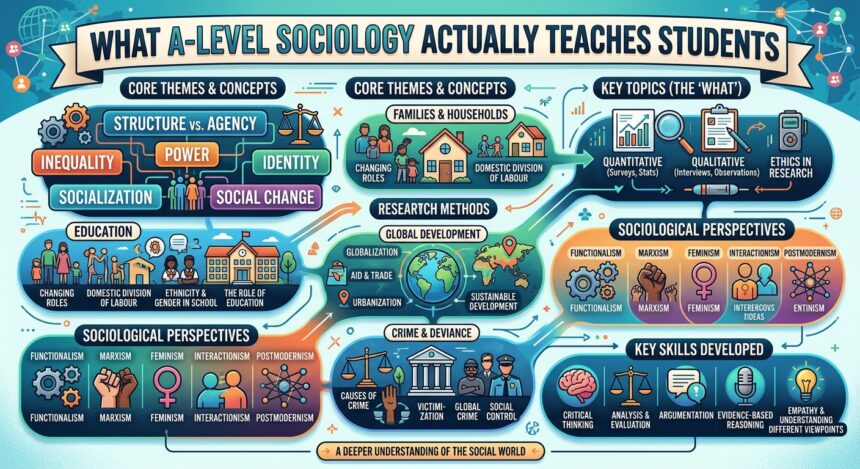
What A-Level Sociology Actually Teaches — And Why More Students Should Consider It
Sociology rarely makes a shortlist of “serious” A-Levels, which is a strange fate for a subject that directly underpins law, journalism, policy-making, human resources, marketing and psychology — fields that all depend on understanding how groups of people actually behave, not just how individuals think.
The subject examines how identity, education, family structure, crime and media shape society, using the same research methods — surveys, case studies, statistical analysis — that professional researchers use to study real social trends. A student isn’t just learning facts about society; they’re learning how conclusions about society get built and, just as importantly, how they can be built badly.
It teaches students to question data, not just accept it
A recurring theme throughout the course is methodology: how a study was conducted, whether its sample was representative, and what its findings can and can’t actually prove. This is a genuinely transferable skill in an era of viral statistics and confidently stated “studies show” claims circulating online — a sociology student is trained specifically to ask the follow-up question most people skip.
It’s one of the most direct routes into understanding current events
Topics covered under A-Level Sociology online — inequality, education policy, media influence, family change — aren’t abstract theory disconnected from the news. They’re the exact frameworks journalists, policy advisors and campaign strategists use to explain why a particular policy succeeded or failed. Students who’ve studied the subject often describe reading the news differently afterwards, spotting the underlying social dynamic a headline is actually describing.
It suits students who ask “why” more than “what”
Unlike subjects built around a fixed body of facts, sociology rewards students who are naturally curious about why people behave the way they do in groups — why a particular social policy backfires, why crime rates shift, why family structures have changed generation to generation. Students who find themselves debating these questions outside of class are often the ones who thrive most in a formal sociology course.
Access matters more here than in most subjects
Sociology is taught at fewer schools than core subjects like maths or the sciences, which means a genuine interest in the subject doesn’t always translate into the option to study it. A-Level Sociology distance learning exists largely to solve exactly this problem — giving students at schools without a sociology department access to the subject without switching schools, taught by specialists rather than a generalist covering it as an add-on.
For students weighing subject choices with career flexibility in mind, anA-Level Sociology online course is worth a genuinely serious look — not as a “soft option,” but as one of the more directly applicable subjects to law, media, policy and social research careers that a sixth-form timetable offers.