

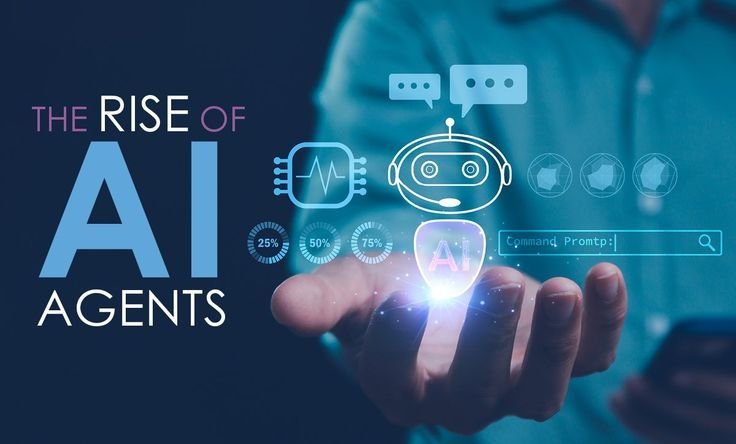
Artificial Intelligence (AI) has evolved rapidly over the past decade, moving from simple automation tools to sophisticated systems capable of reasoning, decision-making, and autonomous task execution. One of the most significant developments in this evolution is the emergence of AI agents—intelligent software systems that can perform tasks, interact with users, analyze data, and make decisions with minimal human intervention.
As businesses seek greater efficiency, scalability, and innovation, AI agents are becoming a powerful tool for transforming operations across industries. From customer service and marketing to finance and supply chain management, these intelligent systems are redefining how organizations work and compete.
What Are AI Agents?
AI agents are software programs designed to perceive information, process data, make decisions, and take actions to achieve specific goals. Unlike traditional automation tools that follow predefined rules, AI agents can adapt to changing circumstances, learn from interactions, and handle complex workflows.
These agents often combine technologies such as machine learning, natural language processing, large language models, and data analytics to perform tasks that previously required human involvement.
For example, an AI agent can answer customer inquiries, schedule appointments, analyze market trends, generate reports, and even coordinate multiple business processes simultaneously.
Why AI Agents Are Gaining Popularity
The rise of AI agents is driven by several factors. Advances in computing power, cloud infrastructure, and generative AI have made intelligent systems more accessible and affordable for businesses of all sizes.
Organizations are also facing increasing pressure to improve productivity while reducing operational costs. AI agents offer a solution by automating repetitive tasks and enabling employees to focus on higher-value activities.
Additionally, customers now expect faster responses, personalized experiences, and round-the-clock service. AI agents help businesses meet these expectations without significantly increasing staffing requirements.
Key Business Applications of AI Agents
Customer Support
Customer service is one of the most common applications of AI agents. Modern AI-powered assistants can handle inquiries, resolve common issues, and provide support 24 hours a day.
These systems can significantly reduce response times while improving customer satisfaction. Human agents can then focus on more complex cases that require empathy or specialized expertise.
Sales and Marketing
AI agents are increasingly being used to generate leads, qualify prospects, personalize marketing campaigns, and analyze customer behavior.
By processing large volumes of data, these agents can identify trends and recommend strategies that improve conversion rates and customer engagement.
Businesses can also use AI agents to create content, manage social media interactions, and optimize advertising campaigns.
Human Resources
Recruitment and employee management are becoming more efficient through AI-driven solutions. AI agents can screen resumes, schedule interviews, answer employee questions, and assist with onboarding processes.
This reduces administrative workload and allows HR teams to focus on strategic initiatives such as talent development and employee retention.
Finance and Accounting
Financial departments are using AI agents to automate bookkeeping, process invoices, monitor expenses, and detect anomalies in financial transactions.
These capabilities improve accuracy, reduce manual errors, and provide faster access to critical financial insights.
Supply Chain Management
AI agents can monitor inventory levels, forecast demand, identify supply chain disruptions, and recommend corrective actions.
By improving visibility and decision-making, businesses can reduce costs and increase operational efficiency.
Benefits of AI Agents for Businesses
One of the most significant advantages of AI agents is increased productivity. Tasks that once required hours of manual work can now be completed in minutes.
AI agents also enhance scalability by allowing businesses to handle larger workloads without proportionally increasing staffing costs. This is particularly valuable for growing organizations that need to manage expanding operations efficiently.
Another benefit is improved decision-making. AI agents can analyze vast amounts of information quickly and provide insights that help leaders make informed business decisions.
Additionally, businesses can offer better customer experiences through faster responses, personalized interactions, and continuous availability.
Challenges and Risks
Despite their advantages, AI agents are not without challenges. Businesses must carefully consider issues related to data privacy, security, and regulatory compliance.
There is also the risk of overreliance on automation. While AI agents can perform many tasks effectively, human oversight remains essential for strategic decisions, ethical considerations, and complex problem-solving.
Another concern is the accuracy of AI-generated outputs. Businesses must establish processes to verify information and ensure that automated decisions align with organizational goals and values.
The Future of AI Agents
The capabilities of AI agents are expected to expand significantly in the coming years. Future systems may collaborate with one another, manage entire workflows autonomously, and perform increasingly sophisticated business functions.
Organizations that embrace AI strategically are likely to gain competitive advantages through improved efficiency, innovation, and customer engagement.
Rather than replacing human workers entirely, AI agents will likely serve as intelligent partners that augment human capabilities and enable teams to accomplish more with fewer resources.
How Businesses Can Prepare
Companies interested in adopting AI agents should begin by identifying repetitive and time-consuming processes that can benefit from automation.
Successful implementation requires clear objectives, high-quality data, employee training, and ongoing monitoring. Businesses should also establish governance frameworks to ensure responsible and ethical use of AI technologies.
Starting with small pilot projects allows organizations to evaluate results, gain experience, and scale adoption gradually.
Conclusion
The rise of AI agents marks a major shift in how businesses operate. These intelligent systems are transforming customer service, marketing, finance, human resources, and many other functions by automating tasks and enhancing decision-making.
While challenges related to security, accuracy, and governance remain, the potential benefits are substantial. Businesses that understand and leverage AI agents effectively will be better positioned to improve efficiency, deliver superior customer experiences, and remain competitive in an increasingly digital economy.
As AI technology continues to evolve, AI agents are likely to become a fundamental component of modern business strategy rather than a temporary trend.
Frequently Asked Questions (FAQs)
What is an AI agent?
An AI agent is an intelligent software system that can analyze information, make decisions, and perform tasks autonomously to achieve specific goals.
How are AI agents different from traditional automation?
Traditional automation follows predefined rules, while AI agents can learn, adapt, and respond to changing situations using advanced AI technologies.
Which industries can benefit from AI agents?
Almost every industry can benefit, including healthcare, finance, retail, manufacturing, education, logistics, and customer service.
Can AI agents replace human employees?
AI agents can automate many routine tasks, but they are more likely to augment human workers rather than completely replace them. Human judgment and creativity remain essential.
Are AI agents expensive to implement?
Costs vary depending on complexity and scale. However, advances in cloud computing and AI platforms have made AI agents increasingly accessible to businesses of all sizes.
What are the main risks of using AI agents?
Key risks include data privacy concerns, cybersecurity threats, inaccurate outputs, regulatory compliance issues, and excessive dependence on automation.
How can a business start using AI agents?
Businesses should begin by identifying repetitive processes, selecting suitable AI tools, running pilot projects, and establishing governance policies for responsible implementation.