
The world of work is changing faster than at any point in modern history. A decade ago, most employees commuted to offices five days a week, meetings happened in conference rooms, and automation was largely limited to factories and repetitive industrial tasks. Today, work can happen from almost anywhere, teams collaborate across continents in real time, and artificial intelligence is beginning to perform tasks once considered uniquely human.
The global shift toward digital transformation accelerated dramatically during the COVID-19 pandemic, forcing organizations to experiment with remote work at an unprecedented scale. What initially appeared to be a temporary adjustment quickly evolved into a permanent transformation of workplace culture. Employees discovered the flexibility of working from home, companies realized they could reduce overhead costs, and technology providers rushed to create better tools for virtual collaboration.
At the same time, automation and artificial intelligence have advanced rapidly. Businesses now use AI systems to analyze data, generate content, answer customer questions, manage workflows, and even support decision-making. Machines are no longer only replacing manual labor; they are increasingly augmenting or replacing cognitive tasks as well.
This transformation raises a major question for governments, employers, and workers alike: What does the future of work actually look like? Will remote work become the global standard? Will hybrid workplaces dominate because they balance flexibility and collaboration? Or will automation eventually reduce the need for human workers altogether?
The answer is likely more complex than choosing one model over another. The future of work will probably combine remote flexibility, hybrid collaboration, and intelligent automation into a new ecosystem where technology and human creativity coexist.
Understanding the Evolution of Work
From Industrial Labor to Digital Productivity
The history of work has always been shaped by technology. During the Industrial Revolution, machines transformed agriculture and manufacturing, moving millions of people from farms into factories. In the twentieth century, computers changed office work, increasing productivity and creating entirely new industries.
The twenty-first century introduced the internet economy, cloud computing, smartphones, and global connectivity. Suddenly, physical location mattered less than digital access. Employees could communicate instantly with colleagues thousands of miles away. Businesses could hire talent globally instead of limiting recruitment to local markets.
This digital evolution laid the foundation for remote and hybrid work long before the pandemic accelerated adoption.
The Rise of the Knowledge Economy
Modern economies increasingly rely on knowledge workers rather than physical labor. Software developers, marketers, financial analysts, designers, writers, consultants, and customer support professionals can often perform their duties using only a laptop and internet connection.
Because these roles are digitally driven, companies realized that productivity does not always depend on physical presence in an office. This realization challenged traditional assumptions about management, collaboration, and workplace culture.
Why Remote Work Became Popular
Remote work became attractive for both employees and employers for several reasons. Employees gained flexibility, reduced commuting stress, and improved work-life balance. Employers benefited from lower office expenses and access to a larger talent pool.
For many workers, remote work represents more than convenience. It offers autonomy and control over daily routines. Parents can spend more time with their families, individuals can live in more affordable locations, and employees can design work environments that suit their personal preferences.
Technology also made remote work practical. Video conferencing, cloud storage, project management platforms, and instant messaging tools enabled teams to collaborate effectively despite physical distance.
Advantages of Remote Work
One of the strongest benefits of remote work is flexibility. Employees often report higher job satisfaction when they have control over their schedules. Flexible work environments can also reduce burnout by allowing workers to balance personal and professional responsibilities more effectively.
Another major advantage is cost reduction. Workers save money on transportation, meals, and office attire, while employers can reduce expenses related to office space and utilities.
Remote work can also increase productivity in certain industries. Without constant office interruptions or lengthy commutes, many employees are able to focus more deeply on tasks.
Furthermore, remote work expands global employment opportunities. Companies can hire specialized talent from anywhere in the world, while workers gain access to international career opportunities without relocating.
Challenges of Remote Work
Despite its advantages, remote work also presents serious challenges. Isolation is one of the most common concerns. Employees working remotely for long periods may feel disconnected from colleagues and company culture.
Communication can also become more difficult in fully remote environments. Misunderstandings may increase when conversations happen primarily through text or video calls instead of face-to-face interaction.
Another challenge is maintaining boundaries between work and personal life. Some remote workers struggle to disconnect, leading to longer working hours and increased stress.
There are also concerns about career development. Employees working remotely may fear being overlooked for promotions or leadership opportunities compared to colleagues who spend more time interacting directly with management.
What Is Hybrid Work?
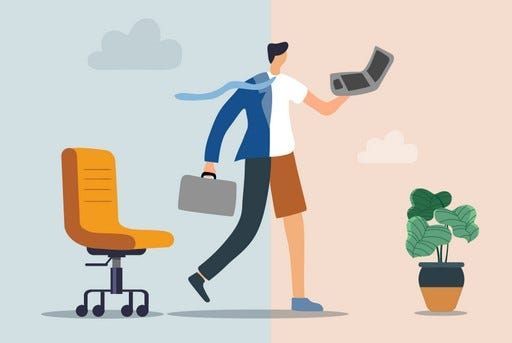
Hybrid work combines remote work with in-office collaboration. Employees may work from home several days a week while coming into the office for meetings, brainstorming sessions, or team activities.
Many organizations view hybrid work as the ideal compromise because it preserves flexibility while maintaining opportunities for personal interaction and teamwork.
Why Companies Prefer Hybrid Models
Hybrid work addresses several limitations of fully remote environments. In-person collaboration can improve creativity, strengthen relationships, and support company culture. At the same time, employees retain some of the flexibility they value.
Organizations also believe hybrid systems can improve employee retention. Workers increasingly prioritize flexibility when choosing employers, and companies offering hybrid arrangements may have a competitive advantage in recruitment.
Another benefit is operational efficiency. Businesses can reduce office space requirements while still maintaining physical locations for collaboration and client interactions.
The Challenges of Hybrid Work
Although hybrid work appears promising, it introduces new complexities. Managing employees fairly across remote and in-office settings can be difficult. Workers who spend more time in the office may receive greater visibility, potentially creating inequality.
Scheduling also becomes more complicated. Teams must coordinate when employees will be physically present, and meetings often need to accommodate both virtual and in-person participants simultaneously.
Maintaining company culture can also become challenging in hybrid systems. Organizations must intentionally create opportunities for engagement, communication, and inclusion.
The Growing Role of Automation
Automation is no longer limited to manufacturing robots. Modern automation includes software systems, algorithms, machine learning, and AI-driven platforms capable of handling increasingly sophisticated tasks.
Businesses now automate customer service through chatbots, analyze massive datasets using AI, and streamline workflows with intelligent software tools.
Automation offers clear economic benefits. Machines can perform repetitive tasks quickly, consistently, and without fatigue. Companies can improve efficiency, reduce errors, and lower operational costs.
Jobs Most Likely to Be Automated
Routine and repetitive jobs are most vulnerable to automation. Tasks involving predictable procedures are easier for machines to replicate.
Industries likely to experience significant automation include manufacturing, transportation, retail, data entry, and administrative support. Self-checkout systems, warehouse robots, and autonomous vehicles are already transforming these sectors.
However, automation is also expanding into white-collar professions. AI systems can now draft reports, generate marketing content, assist with coding, and perform legal or financial analysis.
Human Skills That Remain Essential
Despite rapid technological advancement, certain human abilities remain difficult to automate. Creativity, emotional intelligence, leadership, critical thinking, and interpersonal communication continue to hold significant value.
Jobs involving empathy, strategic decision-making, and complex human interaction are less likely to disappear completely. Teachers, therapists, healthcare professionals, and creative leaders will continue to play essential roles even in highly automated economies.
Rather than replacing humans entirely, AI may increasingly function as a collaborative tool that enhances human productivity.
Employee Anxiety and Uncertainty
Rapid workplace transformation creates uncertainty for workers. Many employees worry about job security, automation, and changing skill requirements.
Fear of technological replacement can increase stress and anxiety, especially in industries undergoing major disruption. Workers may feel pressure to continuously adapt to new tools and systems.
Organizations therefore face an important responsibility: supporting employees through transitions with training, communication, and professional development opportunities.
Mental Health in Remote and Digital Workplaces
Remote work has changed how employees experience workplace stress. While flexibility can improve well-being, isolation and digital fatigue can negatively affect mental health.
Continuous virtual meetings, constant online availability, and reduced social interaction may contribute to burnout. Employees can feel disconnected from organizational purpose and team relationships.
Future workplaces must therefore prioritize mental health support alongside productivity and efficiency.
Global Talent Competition
Remote work enables companies to hire globally, increasing competition in labor markets. Skilled professionals can work for organizations located in entirely different countries, while businesses can access broader talent pools.
This globalization of work may create new opportunities for emerging economies but could also increase wage competition in some industries.
Urban and Real Estate Changes
If remote and hybrid work continue expanding, cities may undergo significant transformation. Demand for large office spaces could decline, while suburban and smaller urban areas may experience population growth.
Transportation systems, commercial real estate, and local businesses dependent on office workers may all be affected by changing work patterns.
Productivity and Innovation
There is ongoing debate about whether remote or hybrid work leads to higher productivity. Some studies suggest employees are more productive remotely, while others argue innovation benefits from face-to-face interaction.
The future may involve balancing individual productivity with collaborative creativity.
Lifelong Learning Becomes Essential
In a rapidly changing economy, education can no longer end after graduation. Workers must continuously update their skills to remain competitive.
Digital literacy, adaptability, communication, and analytical thinking are becoming increasingly important across industries.
The Importance of Reskilling
Governments and organizations must invest in reskilling programs to prepare workers for technological change. Employees displaced by automation may transition into new roles requiring different expertise.
Training in AI tools, data analysis, cybersecurity, and digital communication will likely become essential for many careers.
Should Machines Replace Human Workers?
Automation raises ethical concerns about inequality and economic displacement. If machines perform a growing share of work, societies must address how wealth and opportunities are distributed.
Some experts advocate for policies such as universal basic income or reduced working hours to adapt to technological disruption.
Bias and Decision-Making in AI
AI systems can reflect biases present in training data, potentially leading to unfair hiring, promotion, or evaluation decisions.
Organizations must ensure that automated systems are transparent, accountable, and ethically designed.
What Will the Workplace of 2035 Look Like?
The workplace of the future will likely be highly flexible and technology-driven. Employees may work from multiple locations using immersive digital collaboration tools powered by artificial intelligence.
Routine tasks will increasingly be automated, allowing workers to focus on strategic, creative, and interpersonal responsibilities.
Offices may evolve into collaboration hubs rather than mandatory daily workplaces. AI assistants could manage schedules, summarize meetings, analyze data, and personalize workflows.
At the same time, human-centered skills will become more valuable. Creativity, empathy, adaptability, and leadership may define career success in ways technical expertise alone cannot.
The future of work is therefore unlikely to be entirely remote, purely hybrid, or fully automated. Instead, it will probably involve a dynamic integration of all three.
Conclusion
The future of work is being shaped by technological innovation, changing employee expectations, and evolving economic realities. Remote work has demonstrated the power of flexibility, hybrid models offer balance between independence and collaboration, and automation promises extraordinary efficiency gains.
Yet each model also presents challenges. Remote work can create isolation, hybrid systems require careful coordination, and automation raises concerns about employment and inequality.
Rather than replacing humans entirely, technology will most likely redefine human work. The most successful organizations and workers will be those who adapt, learn continuously, and embrace collaboration between human intelligence and machine capability.
Ultimately, the future of work is not just about where people work or which tasks machines can perform. It is about creating systems that support productivity, innovation, well-being, and meaningful human contribution in an increasingly digital world.
Frequently Asked Questions (FAQs)
What is the difference between remote and hybrid work?
Remote work means employees work entirely outside a traditional office, often from home or other locations. Hybrid work combines remote work with regular in-office attendance.
Will remote work replace offices completely?
Probably not. While many companies support remote work, offices still provide value for collaboration, networking, and team culture. Hybrid systems are more likely to become common.
Which jobs are most at risk from automation?
Jobs involving repetitive and predictable tasks are most vulnerable. These include manufacturing, data entry, transportation, and certain administrative roles.
Can artificial intelligence completely replace humans?
AI can automate many tasks, but human qualities such as creativity, empathy, leadership, and complex decision-making remain difficult to replicate fully.
Is hybrid work better than remote work?
It depends on the organization and employee preferences. Hybrid work offers flexibility while maintaining in-person interaction, but it can also create coordination challenges.
What skills will be most important in the future workplace?
Adaptability, digital literacy, communication, creativity, emotional intelligence, and critical thinking are expected to become increasingly valuable.
How can workers prepare for the future of work?
Workers can prepare by continuously learning new skills, becoming comfortable with technology, and developing abilities that complement automation rather than compete with it.
Will automation create new jobs?
Historically, technological advances have eliminated some jobs while creating others. AI and automation are likely to generate new industries and career opportunities, although transitions may be difficult for some workers.
How does remote work affect mental health?
Remote work can improve flexibility and reduce commuting stress, but it may also increase isolation and digital fatigue if not managed carefully.
What is the most likely future work model?
The most likely future is a blended model where remote flexibility, hybrid collaboration, and automation coexist in different forms depending on the industry and role.